Wednesday, April 22, 2015

Speedier Ferret

As a reward for spending the Easter weekend decorating, we treated ourselves by using our Christmas presents at the Jaguar Heritage Driving experience up in Warwickshire just after the Bank Holiday.

As it’s a little way to travel we went up on Thursday after work and spent a night at Mallory Court again. The journey took a bit longer than expected, so less relaxation time when we got there, which was a great pity as we found we’d been upgraded to a room two levels above the one we’d booked in the main house. The Snowhill room was the size of the footprint of our house, I jest not, and could have been comfortably converted into a one bedroom flat! As well as the bed and built in wardrobe it had a sofa with coffee table, an upholstered bench, two easy chairs with their own table, a third lounge chair, an armoire containing the AV kit and 'fridge, then the dressing table and chair - I'm not sure we own that much furniture! The easy chairs were in the bay window overlooking the kitchen garden and we could have happily spent the evening there imbibing the complementary bevvies and nibbles and watching the LBJs fly round the parterre.

It was such a gorgeous evening that it really was a shame that we’d arrived too late to fit in a stroll around the gardens before dinner, but we had eating to do and although it’s lost its Michelin star since our last visit (the chef has moved) we couldn’t discern any difference in the food; it was excellent and I think the cheese selection was even better than last time. Breakfast was lovely too – I always look forward to the homemade yoghurts that we get at the hotels in the Eden Group, yes, I am that sad.

Then off on the half hour drive to Jaguar’s new testing facility at Fen End, a former RAF base recently purchased from Prodrive - although I believe that the site has historical links to Jaguar. Apparently, Norman Dewiss went round after JLR bought the site last year and said he thought the surface was the same that he drove on 50 years ago so, as one of the instructors said, we would be driving period vehicles on a period surface. Not a scary thought at all… To complete the experience last year Jaguar also bought Dr James Hull’s complete collection of five hundred and odd British cars for approximately £100 million and decided to let members of the general public with more money than sense (i.e. me) drive them. To be fair, I think the cost is pretty reasonable given the hardware you’re using and compares favourably with the track driving we’ve done at Castle Combe. The site itself is very interesting and is home to the JLR Special Operations unit (I think someone got carried away with the James Bond associations there) - we drove past camouflaged testing vehicles on the way to the track and of course, from the look of the carpark, it seemed like everyone else had a much more interesting car than us! From the number of F-Types that drew up we were beginning to wonder if JLR had started to give this out as a freebie to anyone who bought a new one.

I’d bought Jon a passenger ride in an XK150 an hour before my session so it gave us an excuse to arrive early. The reception is in a temporary building whilst they get planning permission for a permanent structure, but it’s a brilliant plate-glass structure in itself. It houses the obligatory merchandising, free refreshments and the 'Jaguar Perfect Ten' as selected by Lord March, Ian Callum and Brian Johnson (that’s the rock star not the cricket commentator) – I tried not to leave drool marks on the XK13... So, plenty to look at as you wait for your session and that’s only inside the building. Outside there are the cars being used for the track sessions and seeing that those include C-, D- and E-Types, an XKSS plus current models, as well as historic cars being used to shuttle instructors around the site, it was difficult to know what to look at first!

Everyone gets a safety briefing then it’s out on track. The XK150 was very cute in British Racing Green and Jon enjoyed his chauffeur-driven laps talking about cars. Then it was my turn. Jon had bought me the D-Type driving experience (which includes the F-Type R as well ‘cos all the driving experiences seem to have to end with an F-Type – never miss a selling opportunity!). I love D- (and C) Types, to me they are just the most beautiful cars ever made and their racing pedigree is the icing on the cake. I never thought I’d touch one or sit in one, let alone drive one, so I think I did pretty well not to run across the tarmac screaming ‘aaaaaaaahhhhhhh, it’s MINE’ when my time came. I held it all together quite well I thought.

There was none of this being driven round the track first by the expert malarkey, oh no, it was straight into the driver’s seat; which was probably a good thing as the passenger side had no door. We’d been told that getting into the D-Type was a bit of an art and, even with a door on the driver’s side, I had to stand on the seat before shimmying down into the cockpit (very glad it was a nice dry day!). Of course the seats don’t move so a cushion was found to push me forward a bit but I was still pretty much horizontal to reach the clutch pedal.

Given the calibre of the instructors I think Jaguar should make more of them on their website but, on the other hand, had I known that my instructor Rob Newall was a Monaco Historic and Le Mans Classic race winner I may not have got into the car! He was lovely and very reassuring. There was a full race harness, but no crash helmet, just headphones so that I could hear Rob’s instructions as we went round the track.

I’ve read some motoring journos on the review day referring to the D-Type as having a ‘difficult’ clutch but perhaps they had a different car to me because it was no more difficult to use than the Spridget’s – no double de clutching needed, just press the pedal all the way and don’t rush the gears, and if you can’t get into a gear just go back to the one you were in and have another go. The only difficult thing was that the gear lever is virtually horizontal, like a handbrake lever, so it was easy to forget what gear you were in (well, that’s my excuse anyway; that and the pheasant watching me from trackside just after Lorry Corner put me off). Start it up, pop it into first and pull away – yes! I didn’t stall!

It was pretty exhilarating bounding along the concrete track – proper wind in your hair and flies in the teeth stuff. After a couple of laps I was getting the hang of the gears and was, according to Rob, taking ‘Stirling Moss lines’ through the chicane at the end of the long straight - I think that meant I was flattening it off. The overtaking was fun and I did manage to get a (VERY unintentional) power over-steer coming out of the last corner, which was mainly down to enthusiasm and a touch of overconfidence (but it still felt good! :0) ). Jon was convinced that I was going faster than the other people he’d seen out on track but the needle was a bit bouncy, plus I didn’t want to take my eyes off the track, so it was difficult to tell what speed I was doing - but it was bouncing between 80 and 100 mph down the long straight at one point. I wasn’t being told to slow down (just the opposite!) and I was meeting all the braking points so I think Rob kept us well within the car and driver’s capabilities. Towards the end of the session when we were haring down the straight it was a nice touch for him to tell me to take the chance to look down the bonnet of the car, just enjoy being there and imagine what it would be like driving this at Le Mans in the 1950s. You don't get an opportunity to do this sort of thing very often so it's nice to take a moment to savour it. There was no-one else due to drive in that session so I think I may have been given a couple of extra laps, but I was possibly ready to come in when we finally came off track – despite being easy to drive it's still a heavy old car with no power steering and needed more weight on the pedals than we're used to these days - although I’d have been ready to charge back out again after a quick de-brief!

Without getting soppy about it, it's such a brilliant idea of JLRs to buy these iconic cars and let us drive them. It was a fantastic experience and well worth doing for anyone with an interest in classic cars. Every time I come off a track I think, ‘I wouldn’t mind having a go at this classic racing game’ but, luckily, I don’t have the finances! And I’m under no illusion that going round a track with 20 other lunatics is very different to going round on your own with an instructor. Still, I can dream… The D-Type’s bodywork is quite soft and it may take a while to tap out the dents my fingertips made as they tried to drag me out of the car. I’m not sure that saline is terribly good for the paintwork either…

Into the F-Type R coupe next. Very nice to look at but I was a bit nervous ‘cos I’ve very rarely driven an automatic. The first impression was that it all seemed a bit overcrowded, it felt like these expensive cars are becoming a bit like an aeroplane cockpit with the number of buttons, switches and dials - but it was nice to be able to adjust the seat to get closer to the pedals! A press of the big gold button to start (no silly start up phrases here) and it did sound good. I got used to not changing gear quite quickly but it did take a bit of nerve to put my foot down and find out just how much acceleration it had - and it really did have quite a lot! It sounded brilliant with the exhaust crackling away down the back straight. Hopefully I didn't break it when I found the bump on the exit of the last corner that I'd managed to avoid on all my laps in the D-Type, after that I had to make it hit the rev limiter before it would change gear - which made it sound even better! The new instructor seemed to think that some of my lines round the track were good and said 'Oh, have you done much circuit driving then?' - I didn't confess that I'd been listening very attentively to Rob as he'd been pointing out apexes on my previous run!

But I have to say that driving the F-Type immediately after the D-Type just made the word 'unengaging' spring to mind. It was a lovely car (the coupe looks SO much better than the soft top) and it felt like you could get it a bit wrong and throw it into a corner and still have a pretty good chance of coming out safely at the other side. The power was very impressive, especially for someone whose normal drive is a 15 year old 1.6 small family hatchback. But it just didn't compare to the older kit and just left me feeling a bit, well, 'meh'. Perhaps it was not having to change gear that left me feeling uninvolved, but I won't be putting it on my Christmas present list. I did like the way that, when you switched the engine off, the steering wheel moved out of the way to make it easier for you to get out and all the pop-up air vents decended gracefully into the dashboard!

We hung around for nearly an hour after my last session, savouring the atmosphere and the coffee in reception and wandering around the exhibits again - in fact we had to wait a while because after a morning of glorious sunshine it suddenly started hammering down and as we'd left our brollies in the car we didn't want to get soaked. We'd been very lucky with the weather and felt sorry for all of those turning up to do their laps in the wet.

Then off for a drive home that was a lot less interesting. And, yes, I have put a D-Type on my birthday present list!

These are a couple of nice articles done after the launch of the experience days at the back end of last year:

http://www.xclusively-jaguar.co.uk/xclusively-jaguar-news/view/400-jaguar-heritage-drive-day

http://www.historicracer.com/editors-diary/jaguar-heritage-driving-experience-goes-live/

Labels: , , , , , , , , ,

Tuesday, March 17, 2015

Dorset Dalliance

Taking a break from decorating (dining room done, living room scheduled in for Easter weekend) we spent last weekend in Dorset. We were booked in to look around some archaeological stuff with Devizes Museum on Saturday and, as we didn’t want to get up at the crack of crow-sh!t on a Saturday morning we thought we’d use the trip as an excuse to make a weekend of it (you may remember that we went to Wroughton with them in 2011).

The weather was due to be awful but it really brightened up on Friday and by the time we left work it was actually sunny. First stop was the Sixpenny Brewery at Manor Farm in Sixpenny Handley. Their ‘pub’ which doubles as the off-sales office has very restricted opening hours – closing at 6.30 on a Friday evening – would we be able to find it? Would it really be open? As we couldn’t imagine much passing trade in this area of the country so we thought the opening hours might be more erratic than those published. But we arrived in good time just before 6 and was it ever open; the farmyard was packed with cars and people coming and going all the time. I managed to squeeze into a gap next to a barn and we grabbed gloves and mufflers before tottering off to the ‘nano-bar’ - their very accurate description not ours – I think they must have used a fisheye lens for the photo on the website ‘cos it looks 3 times the size of the actual bar!

After fighting our way through the crowded bar we stood outside with our beers. It was the most gorgeous crisp and clear (and freezing) March evening – we could have done with grabbing our coats as well as the gloves and mufflers. We could hardly wipe the grins off our faces as it really was an idyllic setting (well, as idyllic as any working farmyard can be on a lovely evening with a pint in your hand). We’d come well prepared so Jon filled up our bottle basket with take-outs for sampling next weekend at home (luckily they do 6 brews and our bottle basket has six spaces) and we returned to the car (with envious men making sotto voce comments as we passed like ‘That’s what I call a shopping trip!’).

Then off down the road to our hotel, the Castleman at Chettle. A lovely country house hotel with rooms that only cost the same as the ones in the pubs in the surrounding villages. In fact our room was so big – even with the sofa at the end of the bed in front of the fireplace the room didn’t look cramped or over-stuffed - that we thought we’d been put in one of the large doubles by mistake but no, they were all like that.

The lovely panelled bar and the lounge did have cosy fires burning all the time, but it’s definitely a real country house (still owned and run by the family) rather than a sanitized corporate makeover so putting an extra layer on before going downstairs was a good idea. I do hope we find the opportunity to go back sometime because the food was great and the hospitality unfaultable.

The core of the building is possibly Tudor but most of the bits you see now were built in the 1700s or later. The staircase was great and one of the overmantels was very good. I don’t want to get too feudal or deferential about this but it is a bit amazing for us lower middle class types who were brought up, and still live, in modern boxes to have the chance to stay fleetingly in the type of houses that we usually pay the National Trust to be able to wander around for an hour on a Sunday afternoon. To be able to spend as much time as I wanted in front of the Jacobean fireplace (not as much time as I should have spent) or sitting in the Georgian lounge with plasterwork so delicate it might have been on a Wedgewood vase is very special. Someone has a good eye for 20th century art because, whilst most of the paintings looked like old family pieces, the Jessica Brown still lifes in the dining room and the small (alabaster? marble? I’m not very good on stones!) horse in the lounge were lovely (I really should have asked who’d done it).

Anyway, Saturday was a trip back to Sixpenny Handley to see farmer/archaeologist Martin Green’s museum and some of the excavations he’d undertaken on his land. The weather was beautiful when we went into the museum but, sadly, grey and blustery when we came out to start our walk around Martin’s reconstructed excavations – and there’s not much to stop the wind whipping across the Cranborne Chase! If anyone is interested there are details of a couple of things we saw, the pond barrow and the shaft at http://digitaldigging.net/cranborne-chase-archaeology/. The shaft is amazing – Martin got 13 metres down it before being stopped by the water table, but it’s been augured to be twice as deep. It can now be viewed from a bridge above and we can confirm that it’s definitely a bloody big hole

Lunch at the Inn at Cranborne then off to the Ancient Technology Centre. We’d been to a lecture at Devizes Museum by Luke Winter just before Christmas that was brill and he was just as informative and funny showing us around the reconstructions on site. It’s an experimental archaeology centre where they try to recreate ancient buildings using ancient techniques and materials but using children to do the work. It’s fascinating; with a reconstructed Viking longhouse, Isle of Man earthhouse, Iron Age roundhouse, Roman forge and more, recreated from the archaeological evidence. Most children come to visit on a regular basis to help with the builds, but when groups of children come to stay overnight in the longhouse they have to butcher their own meat, make bread, chop vegetables and cook on the open firepit – they claim never to have lost a child, or a bit of a child, yet (but many parents must still send theirs’ along in hope…)!

If you like Time Team you may remember the Special in which they recreated a Roman water wheel based on pieces that had been excavated in London at the start of the millennium. The Museum of London donated it to the ACT so many of our group had fun trying it out!

Then back to the hotel for a beer and a soak in the bath to get the smell of wood smoke out before dinner. All-in-all a brilliant way to spend a weekend.

Devizes Museum put on a great range of lectures and events throughout the year, details of which can be found here.

Labels: , , , , , , ,

Tuesday, April 22, 2014

Athens

We spent February half-term week in Athens - 20c and sunny, in case you were going to ask, which was much nicer than grey and wet Wiltshire. The perfect weather and temperature for serious sight-seeing. We went with Andante again who put us up in the Herodion Hotel

which really did have this view of the Acropolis from the roof terrace, with a view into the Acropolis Museum on the other side. It was a very well located hotel, handy for many of the sights and for the restaurants in the Plaka, plus it had an excellent little bistro/bar for when we were just too knackered to make it back out at night!

Day 1

We walked up the Acropolis hill, past the Theatre of Dionysus (5th century BC or earlier) and the Odeion of Herodes Atticus (theatre 2nd cent. AD). The views over Athens and up at the protective walls of the Acropolis were stunning. I loved the green spaces around some sides of the hill which then give way to remnants of the old town clustering close to the Acropolis, seemingly for protection.

The Acropolis still dominates the city, as it has since at least 1400BC when the Mycenaeans built a palace there. It's such a great defensive and ostentatious site that successive inhabitants must have been drawn there from the earliest times. In the 6th cent. BC temples, treasuries and a formal entrance (Propylaia) were built but were destroyed when the Persians attacked in 480BC. Rather than rebuild immediately, the Athenians chose to bury the sculpture and use the stones from temple columns and walls in strengthening the defences - these massive column drums can still be seen in the walls that surround the Acropolis today.

The Athenians rebuilt the temples on the Acropolis between 447 and 406BC. The largest and most iconic is the Parthenon but it is possible that the Erechtheion was the most important to contemporary residents, and had been for along time as it contained the original 'statue' of Athena - Mary Beard says that by the 440s BC it was, "...little more than an olive-wood plank...Its sacred status came...from its extreme antiquity"*. The Temple of Nike (Athena as Victory) and the Propylaia were also re-built at this time. The trip to the Acropolis proved the wisdom of visiting at this time of year. During busier holiday periods it is just crammed with people - I know 'cos I was there nearly 30 years ago in August - but there were few large groups up there with us and, if you waited a short while, almost any view would clear of people long enough to take a photograph or get a better perspective. I think that the crane inside the Parthenon is the same one that I saw in 1986, but the scaffolding has moved around a bit!

After lunch - we chose cheese or spinach pies most days (sublime!) - we visited the Greek Agora, the civic heart of the ancient city. Along one end of it is the Stoa of Attalos (a covered walk-way which would have had a range of uses) that has been restored and now houses a sweet little two storey museum and storage rooms for finds. But one of the main reasons to visit the Agora is to see the Hephaisteion, a very well preserved 5th cent. BC temple which gives a good idea of what the Parthenon would have looked like. Like many ancient buildings that have survived into modern times, it survived because it was taken over by the early Christians - OK they did have a tendency to deface sculptures and carve their own images over things they didn't like, but at least most of the building survived!

Day 2

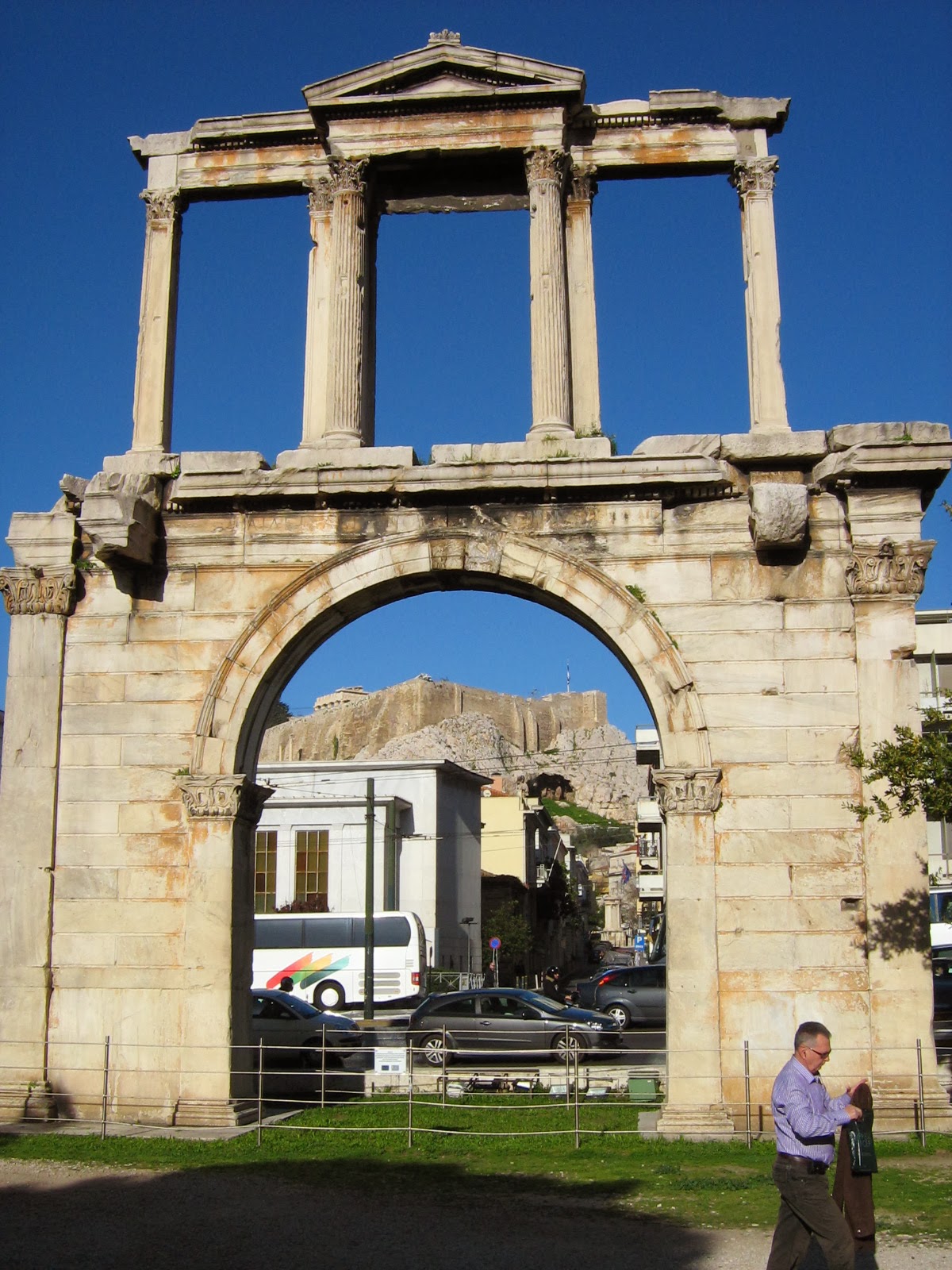
Some of the intended visits had to be re-jigged because of 'winter opening hours' and ad hoc strikes. I would humbly suggest that a country that's economically stuffed would do better to keep their monuments open beyond 3pm to screw as much money out of tourists as possible. We started today with Hadrian’s Arch - by the side of a road so no chance of that being closed! But a planned visit to the Kerameikos district had to be shelved because of strike. I think that the Greek tour guide who accompanied the Andante guide was quite embarrassed at the negative impression she thought the strikes were giving us of her country, and I don't think she was consoled by one of the older members of our party exclaiming, "It's Greece, we expected it!".
Instead we had a brilliant walk around the flea market in the Monastiraki district, culminating in the fantastic little Panagia Gorgoupekous - Agia Eleftherios church on Mitropoleos Square. It's a 12th cent. church but the builders re-used all sorts of sculpture, pediments and cornices from earlier buildings completely out of context and with no knowledge of architectural conventions (a triangular pediment floats in a wall nowhere near a door), which makes it fascinating to walk round. Scenes were often 'Christianized' by simply adding a cross between the images. A really lovely little place.

Then off to the Library of Hadrian, which we were surprised to find was full of tortoises! We'd spotted one yesterday as we'd walked past the entrance and hadn't quite believed our eyes, but at least 5 of them were charging around - and they really can move pretty quickly too. Lunch was at the new Acropolis Museum (which we could see into from our hotel - very nice when it's lit at night and you can see the sculptures from our hotel's roof terrace), followed by a tour.
It's nice to get up close to sculpture that would once have been high on a building, oh, and the original caryatids from the Erechtheion on the Acropolis (the girlies who hold the roof up with their heads) are there too. I always like to see the bits of original paint on all these statues and bits of architecture - I think we'd have been shocked to see these statues, that have come down to us as pure white marble, in their original gaudily painted state.

Jon took the guided walk to the Pnyx (a rocky hillside where the council of Athens used to meet in the 6th cent. BC) whilst I went and put my feet up!

Day 3

Today we had a coach trip north out of the city to the sanctuary of Apollo at Delphi, in a wonderfully dramatic mountain terrace setting. I don't think any of us had realised that Greece had a skiing region so we were rather surprised to find that Mount Parnassus had a snow-sports resort. Unfortunately, the bad weather that had been depositing rain on the UK from December to February had not been falling as snow in Greece, so I think trade was a little thin, but it was quite surreal to drive past alpine-style chalets and through towns stuffed with ski/snowboarding shops. As we drove past trees whose pink and white blossoms were coming out, with the snow-capped mountain in the background, it all looked rather Japanese.

Delphi was thought to have been the 'belly-button of the world' by the ancient Greeks (an 'outie' rather than an 'innie' if the stone at the site is anything to go by!) and seems to have been the site of an important oracle from as early as the 1400s BC. The oracle or prophecies were delivered by a priestess, who sat on some sort of tripod over a chasm in the inner sanctum of the temple. It is thought that she inhaled the gases which came up from this volcanic region and then delivered the prophecies in a trance. Every four years Delphi also held the second most important of the series of four Panhellenic games that the modern Olympics are based on (the other 3 being held at Olympia, Nemea and Isthmia).

These ancients certainly knew how to pick a picturesque spot. Delphi is simply stunning and well worth a trip just to look at the view - in fact I was so busy goggling at the view that I almost missed the theatre in this photo that was right behind me! It's a rather vertiguous site though and is quite a climb from the entrance at the bottom to the stadium at the top. I'd hate to do that climb in the heat of summer when it's rammed with parties of school kids and you can't even fit a fag-paper between the tourists. The small on-site museum holds some of the best items that have been discovered at Delphi, including the charioteer, but I was fascinated by some tiny but beautifully carved ivory figures hardly an inch high; as well as the painted stonework from the temples and a style of column that I'd not seen before. As usual, photos are in the gallery on the right =>

On the way back to Athens we stopped off at the Byzantine monastery and World Heritage Site of Hosios Luscas. The monastery was founded in the late 900s AD in a beautiful setting on Mount Helikon and is dedicated to St Luke of Steiris who died in 946AD - he, or rather his 'relics', now lives in a glass box to the right as you enter the church. The outside of the buildings were gorgeous but the mosaics and frescos inside were simply stunning; I'm always amazed that such things can survive over a thousand years of earthquakes, wars and redecoration. Sadly my camera couldn't do them justice and it was a little disappointing to see relatively inexpensive 'phones capturing much better images than my 8 year old Canon Powershot. Once again I thought that I may have to upgrade...

Day 4

The morning was spent having a quick guided tour of the National Archaeological Museum in Athens, with one of the finest collections in the world we decided that a morning wasn't enough so we had lunch and then explored it on our own. I'd spotted what appeared to be a temporary exhibition bringing together all the finds from the Antikythera shipwreck into one space (they're usually spread around different rooms of the museum) so I was desperate to see it - sorry, I am that boring, 'desperate' was not an exaggeration! The wreck was discovered by sponge drivers off the coast of the Aegean island of Antikythera in 1900. It appears to have sunk in around 70BC and was carrying a treasure trove of some of the best Greek art of the previous 400 years, leading archaeologists to believe that it was taking art looted by the Roman General Sulla back to Julius Caesar in Italy. Again, I'm stunned that such delicate glasswork survived intact for over 2000 years and I loved the contrast in decay between a bit of a sculpture that had been buried in the sea bed and the part that had been exposed to the sea.

But the highlight was a series of corroded bronze lumps made up of various cogs and gears which formed what's become known as the Antikythera mechanism, or 'the world's oldest computer'. It took archaeologists and engineers the best part of 100 years to analyse it and the exhibition has various examples of that they think it would have looked like. It's a fascinating and complex piece of equipment that seemed designed to predict astronomical events, eclipses and other data relevant to the ancient Greeks, such as the date of various Olympiads. Although one might think that it was designed as a navigational aid (especially as it is transportable and appears to have its own instruction manual) it looks like it was part of the loot, as the metal would not have stood up to the corrosive salt-laden atmosphere and it seems to have too much unnecessary data. This object does not seem to have been rare in the classical Greek-speaking world but, although some elements of this ancient technology were preserved by the Byzantine and Islamic cultures after the fall of the Roman empire and later travelled back into Europe via the writings of Islamic scholars, it took over one thousand four hundred years for anyone in the west to create anything using a geared or clockwork mechanism - and these first mechanical clocks were still much simpler than the Antikythera mechanism. If you have even a small element of geekiness about you
(either archaeological or technological) keep your eye open for BBC Four's brilliant 'The two-thousand-year-old computer' which pops up every few months and tells the fascinating story of the decoding of these corroded bronze lumps.

There are such treasures here, like the Cycladic figurines which influenced the 20th century modern artists, but a day wasn't enough.

Jon took the guided walk to the Philopappos Monument whilst I, again, put my feet up. This is an ancient mausoleum dating to about 116AD on the top of Mouseion Hill which gives stunning views over the Acropolis and the city.

Day 5

We managed to fit in a quick visit to Kerameikos (area of the potters) which had been closed the other day due to a strike. This was the most important cemetery in ancient Athens but also had the Dipylon Gate which was the favourite entrance to the city and led to Plato's academy, and the Sacred Gate which led to Eleusis. The rich lined these two roads with lavish tombs until such extravagance was outlawed in the 300s BC when only small columns were allowed as grave markers although, strangely, some people still managed to have bigger columns than others... There's a cracking little museum which, as well as the usual marble statues, has some really interesting everyday items like make-up boxes with face-powder and other tints still inside.

Then onto Attica to the stunningly situated Sanctuary of Athena Sounias and Temple of Poseidon on a headland at Sounion. Lord Byron carved his name on the temple in 1810 - when I visited 30 years ago you were allowed into the temple and up to the column that he graffitied, so close that you could actually touch it (although I just took a photo instead, honest), but now you have to keep a respectful distance. There were lots of other graffitied blocks to photograph this time!

On to the ruined ancient city of Thorikos, famous for its silver mines, on which the Athenian economy depended - 20,000 slaves were employed at its height. This was the sort of place that we come on specialist archaeological tours to visit, no-one else was there for the entirety of our visit, so, well off the beaten track so to speak, even though it was at the side of he road and completely free of charge. It has one of the earliest surviving theatres in Greece, which is also an unusual rectangular shape. There is a restored ore-dressing and washing floor next to the entry to one of the mines. Again, it's a lovely spot and all the spring flowers were in full bloom. I was thrilled to find a bit of graffiti from a Soviet sailor who must have docked at the port we could see just across the bay in 1972 - he even drew a picture of his trawler!

It was a great trip and a really beautiful time of year to visit. We've visited Rome and Athens now in February and it does seem to be a great time to go: few tourists, lovely (if very cold in Rome) weather and very relaxed. All photos will be uploaded to the album asap.


* The Parthenon, Mary Beard, Harvard Uni Press, 2003, p.147

Labels: , , , , , ,

Thursday, August 02, 2012

Southern 100

We're recently back from a week in the Isle of Man watching the Southern 100 motorbike road races with my Dad. The weather was lovely all week – who'd have expected that? - we've come back sunburned and there was only one brief rain shower during a support race on the Wednesday evening, which caused it to be shortened to 4 laps (but the sidecar practice after it went ahead). We went over on the Sunday evening ferry from Liverpool, which was absolutely heaving with IoM residents heading back after their 4-day bank holiday weekend. We stayed at the Sefton Express airport hotel in Ballasalla – along the lines of a Travelodge but the staff were lovely, it was very handy for the racing and public transport, plus they had lots of Okells beers... well, slightly less by the time we left. Practice was Monday and Tuesday evenings with some racing also on Tues but the main racing starting on Wednesday evening and all day Thursday. So that left most of each day for sight-seeing. See lots of photos in the album over on the right =>

Monday

Monday we went to the Laxey Wheel 'cos bits of it were made in Wigan and it's also a pretty impressive mine water-pumping mechanism. As I've mentioned before, I love these ex-industrial areas because they show how quickly nature re-establishes itself once the industry stops; from a polluted wasteland 100 years ago the wheel is now set in a lovely valley and you can walk along the stream, which has trout in it once again, watching the dragonflies flit along over the waterfall. The abandoned and derelict mine buildings only seem to add to the picturesqueness of it for me as, I suppose, the ruined monastic buildings did for the Romantics 200 years ago. Or am I getting too poncey?

We had lunch in a great pub in Laxey, the Mines Tavern, which was right next to the electric tramway station (the trams go from Douglas up to the top of the Snaefell mountain). The bar is brill., not only because it stocks lots of local beers, but 'cos it looks like a tram! We also loved the café at the tram ticket office because it was so old-fashioned. After lunch we took the tram up to The Bungalow (on the TT Circuit) not realising that the motorcycle museum that had been up there was now closed. We had a wander around for an hour, looking at Joey Dunlop's statue and the fantastic view before heading back down in the tram and back to Castletown for the first evening's practice.

The hotel proved even handier for the Southern 100 circuit than we'd expected as a short-ish (mile?) walk across the fields behind the hotel (taking care not to get run over by a steam train when crossing the track!) brought us out just below Church Bends, which we'd heard was a good viewing spot. We settled down amongst the graves in Malew churchyard and waited for the practice to begin. The roads closed at 6.05pm and once the travelling marshals had checked the route was clear the session began. The Southern 100's 'Billown Circuit' is about 4 and a half miles long. The start/finish straight is on the Castletown by-pass and from there it follows a rough square going via Ballakeighan, Ballabeg and Malew.
View Southern 100 in a larger map
If I can get the map to work correctly, the rough square in blue is the circuit with the single blue line wobbling off to the right being the route we walked from the hotel to the circuit. This was my first experience of road racing because, although I've been to the TT before, the weather was too bad for racing (well, that was until they cancelled the day's session and then the sun decided to come out!). I knew that the lads got close to the wall but I was just amazed at how close you actually get to them. We were standing behind the churchyard wall at the apex of the corner and we could have patted them on the back as they went past (had they not been going at 100 mph that is, 'cos I think you'd be patting thin air as they streaked away!) and their heads were brushing the wall. There were better places to stand if you wanted to get good photos – like on the opposite side of the road in the overspill churchyard – but to get the pure atmosphere of road racing I'm not sure that the apex of Church Bends could be bettered.

Guy Martin (pictured) led the first practice sessions for the 1000s and 600s but you could see how hard Michael Dunlop was trying and you could tell he had it hooked up and was just going faster and faster; so by the end of the evening he was topping the timings sheets. Ian Lougher and local boy Conor Cummins (see his horrendous crash at the TT a couple of years ago here) were up there too. There was a short break whilst a sidecar crew were airlifted to hospital, but I understand that it wasn't too serious. There were no serious hold-ups and the roads were re-opened before the scheduled 9.40pm.

We walked back to Ballasalla town and had a couple of pints in The Whitestones (to be recommended, we went back and ate there twice later in the week).

Tuesday

At breakfast two chaps were just booking in after catching the 'plane over from Ireland with some slick tyres for one of the riders. I thought they'd have been for someone we'd never heard of but when we got chatting to them it turned out that they were for Michael Dunlop. He was using, appropriately enough, Dunlops but the tyre suppliers in the paddock were Pirelli so he'd 'phoned the chaps to ask them to collect the tyres for him and bring them over – familiar story for Dad who used to be asked to bring a new exhaust, etc, with him when he came over to support the Porters' riders for the TT. They said that the text explaining where they'd find the tyres was brilliant, along the lines of 'turn left at the blue garage, go a couple of miles up the road and after the farm turn right and at the third gate of the left you'll find two tyres behind the hedge' and there they were at 5.30 that morning touring the country roads of Antrim looking for the tyres!

We kept it local for day two and stayed quite close to Ballasalla. After a look round Castletown we drove around the circuit to see if there was anywhere else we fancied viewing from that evening, but nowhere really caught our attention. We dropped in at Rushen Abbey to look round the ruins and for some nostalgia by the older sections of our party – Dad could remember it being the place to go for cream teas and dancing when the family used to go over in the '50s and '60s. The Abbey's owners had fruit trees planted on the land and made their own famous preserves and held tea dances.

Back to Church Bends that evening, in the car this time - note the eager crowd waiting for the racing to begin... Unfortunately, the only accident of the evening happened here 15 mins before the roads were due to close, when a bike came round the corner only to find a van on his side of the road maneuvering to get through a narrow gate entrance. Luckily it was a low speed hit, although it made a heck of a noise, and he was taken to hospital complaining of arm and neck pain – fingers crossed he was OK and managed to see the rest of the week's racing. The marshals were fantastic; they swung into action directing traffic whilst the course medic treated him before the emergency services arrived. The roads opened less than 20 mins later than expected and by the end of the evening the timing was back on track.

We tried to go to The Sidings in Castletown after the practice but it was absolutely heaving – four deep at the bar – so we went back to the hotel and sampled Okells Maclir and 1907(brewed to commemorate the TT and a slightly excessive 6.1%!) and can pronounce them both excellent - but we kept trying them throughout the week, just to make sure...

Wednesday

Off to Peel today to see the castle. I was happy 'cos almost the first structure through the gate was a garderobe. So, ancient toilet fetish satisfied, I could concentrate on taking nice pictures of the castle! Seriously though, I don't think I've seen as many garderobes in one castle before, the residents were extremely well provided for. By the way, that blue stuff at the top of the photo is what the sky is supposed to look like in summer, rather than the grey we've been used to for the last 3 months...

Lovely lunch at The Creek public house – Jon's kippers (smoked less than 100 yards away) came piled up and in hindsight the side-order of chips may have been a mistake. Bushy's Oyster Stout (made with real oysters apparently) washed it down a treat. Apparently some of the riders were mackerel fishing on the harbour wall, but we didn't spot them.

In the evening we thought we'd try a different viewing spot and chose Stadium Bends at the beginning of the start/finish straight. We caught the steam train at Ronaldsway Halt, just behind the hotel, into Castletown – it stops by The Sidings pub. There are grandstands at Stadium Bends and also up by the start line, but we sat just a little bit further up from the corner. From there you can walk all the way along the start/finish straight, around the paddock, see the riders as they come in to the podium and the first corner.

It was the first proper night of racing with just a sidecar practice at the end. The closest race of the evening was Ryan Farquhar and Jamie Hamilton in the 650 class – team mates on Ryan's own bikes and they were swapping the lead throughout the race with Ryan using a 'wide elbow technique' to discourage Jamie from passing him! Farquhar won by a fraction of a second.

Those tyres of Michael Dunlop's got well-used in his races and he was dominant during the evening. He didn't always get away first but he sooner or later fought his way to the front and streaked away. He looked so relaxed during the sighting laps, arm resting on the tank, foot peddling along the pavement - on one occasion his bike actually was on the pavement! When racing he just seemed so smooth and in control. Guy Martin was second in the races he finished, but had a DNF in the 600 race. His Tyco team-mate Conor Cummins and Ian Lougher were usually dicing for third – very close racing – with Conor getting the best of it by the end. He came second in the races Guy didn't finish. You can find all the results here.

A short shower meant that the last race of the evening, the 125/400s, was shortened to 4 laps, but the sidecar practice ended the session as planned. Caught the bus back to the hotel (it stops just opposite at the airport) and sampled more of the Okells.

Thursday

A full day of racing today, so we drove over to Church Bends and staked our place at the apex of the corner again. The Irish gentlemen from the hotel were there - very happy that their man was doing so well. It was a lovely day but there was a chilly breeze - well, that's my excuse for wearing shades and a sun hat with a mac and walking socks!

Mr Dunlop started where he'd left off the previous evening and won everything he entered. Conor Cummins came second in the races that Guy Martin DNF'd. The racing was great in all the classes. To be honest some of the riders were, to paraphrase Howlin' Wolf, built for comfort rather than speed but they were all heroes as far as I was concerned - look at the photos in the album to see how close to the wall they got. This isn't circuit racing with nice big run-offs if you get it wrong (although that's dangerous enough); the thing you hit here is a house, a garden wall, a tree. Paul Shoesmith (pictured) provided some light relief by turning out in the Evel Knievel leathers that he wore at the TT - complete with tassels!

The church at Malew is lovely, with original box-pews, balcony and a very unusual banked aisle. Members of the church opened the kitchen today and did drinks, burgers, sausages, etc to raise money for the church funds. I hope they did very well. The church is well worth a visit if you're on your way back from Castletown or Ports Erin or St Mary.

After a fantastic day's racing it was off to Castletown Square in the evening for the prize-giving. Everyone received a plaque for taking part was well as those who were up there to collect cheques and silverware. It was nice to stand in the Square next to world famous and not so famous riders, all of whom seemed happy to sign autographs or shake hands with the fans. Unfortunately, all riders look the same with their helmets on so I didn't recognise most of them until Jon pointed them out! Except Conor Cummins, of course, 'cos he's ten foot tall and even though I was standing on the Smelt Monument he still blocked my view of the stage!

Michael Dunlop's clean sweep of wins and 4 new lap records, including an absolute track record, meant that for his final trip to the stage the organisers had to give him a very unglamorous large cardboard box to take all his trophies away in! Local boy Conor Cummins got the loudest cheers every time he went to the stage - as did his Dad when he collected his winner's trophy for the Junior Support Consolation Race. Guy Martin was conspicuous by his absence to collect the first 2 of his 2nd place trophies - I think he was at the back of the bar in the George Hotel and couldn't get out (well, that's my charitable interpretation anyway!) - but he made it out at the third attempt and went off with an armful of trophies.

Friday/Saturday

We started the day with a trip to the steam museum at Port Erin which is quite literally at the end of the line on the most southerly stop on the Isle of Man Steam Railway. So you get to see the trains coming in and out of the shed as well as the static ones displayed in the museum.

Then we had a trip up to Douglas to have a mooch around the shops. We didn't buy much today but bought loads when we were waiting for the ferry on Saturday! We had a nice afternoon tea at the Alpine Cafe on Regent Street and on Saturday we enjoyed our lunch at The Velvet Lobster on North Quay

We popped into the Tourist Info Office to find out where the bikes from Murray's Motorcycle Museum at the Bungalow had ended up and were told that Peter Murray now has them at a museum at his home in Santon. The lady gave us the details but suggested that we ring first because the opening times could be somewhat erratic. So, we headed back to the hotel and, as we went through Santon, we noticed that for the first time that week the museum's sign was out so we decided to pay a visit. To find it, take the A5 towards Castletown. When you see the house (pictured) seemingly in the middle of the road, the museum is through a farm gate on the left of the house. If you get to Fairy Bridge ('Hello fairies') you've gone too far. It's an amazing collection, all the more interesting because it's now just in a large two story garage - it reminded us of the Atwell-Wilson Motor Museum near us in Calne.

Mr Murray was on hand to provide teas and coffees and lots of information. Whilst we were there one of the riders from the Southern 100 and his wife were looking round (possibly Chris Palmer, but I didn't like to let on that I didn't recognise him - see my comments above about all riders looking the same...), plus a TT marshal, so I think it gets the more knowledgeable type of bike enthusiasts. There were some brilliant bits of engine on the bench with melted bits to illustrate what happens when a piston lets go, etc. We'd not meant to stay long but it was almost 2 hours later when we made our escape.

Dinner in the evening was with friends of my parents at The Garrison - again very generous portions and I had to give my side dishes away, sob.

Back home on the Saturday after a shopping trip to Douglas, thankfully the ferry was a little quieter!

It looks like the races are on Eurosport2 over the weekend of the 4th August and into next week - look out for 'Motorcycling: Southern 100' and 'Motorcycling: Billown Races' each day.


Labels: , , , , , , , , ,

Tuesday, April 24, 2012

Arrivederci Roma

We're recently back from a week in the 'Eternal City' having finally managed to go away with the company that we've been trying to go to Syria with for the last year. After looking forward to a trip for so long we were a bit worried that we might be disappointed but we had a fantastic time. Our guide, Oliver, is a proper working archaeologist and was brilliant - knowledgeable, approachable, flexible.
We thought that the Ferret Holiday Curse had struck again because, as well as the Italian economy being f**ked, it snowed in Rome for the first time in over twenty years the week before we arrived! They even closed the Colosseum to visitors on health and safety grounds (yes, who knew that they have health and safety on the continent?). I'm not sure that this picture actually shows just how cold it was at 9am!

We took our own flights from Brizzle 'cos we couldn't be bothered trying to get to Gatwick - life's too short. Luckily, our flight arrived only 20 mins after the main group's did and we spotted them in the arrivals hall which meant that we were able to get a lift in the coach rather than having to find our own way to the hotel - admittedly that wouldn't have been difficult, but it was nice to meet Oliver and the rest of the group early on.

The hotel, Pace Helvezia, was really handy for the Forum and lots of other sites. We liked it but there is some criticism on Trip Advisor of its small bedrooms. Ours was at the back of the hotel, so reasonably quiet for a room in the middle of a busy city, the bedroom size was fine and the bathroom was huge. The public areas did need some updating and the bar was never open, but there are lots of other places to go, who wants to spend the evening in their hotel in Rome? The roof terrace was wonderful and I spent a very happy morning on our 'day off' reading in the sun whilst Jon hired a scooter (yes, he did, and survived!).

We had some lovely dinners, although we had to get used to all our meat arriving looking like it'd been run over, as the Romans seemed to flatten all meat for some reason. Oh, and you've got to order your veggies as a side dish. We tried Le Lanterne just over the road from the hotel and I had a fantastic minestrone at La Taverna dei Monti which was bursting with absolutely fresh vegetables and must have been at least 3 of my '5 a day'! We also liked The Glass bar and restaurant just off Piazza Venezia. But we found the drinks everywhere to be really expensive at 5+ Euros for very uninteresting lagers. We finally found the Theatre Café Bar just up the road from our hotel on the roundabout where Via 4 Novembre, Largo Magnanpolis and Via Nazionale meet. The interior has large mirrors with 'Only Bass' on, but sadly no Bass on tap, but they did have Affligem and Erdinger which were cheaper and had more flavour than the gassy local beers. The food was great too - and came with vegetables! We get a bit enthusiastic (greedy) and ordered a starter of antipasti for me and a soup for Jon (which was a proper rustic job, thickened with bread). Then I had a lovely Gateau di Patate which came with a salad and more tiny mozzarella balls than you could shake a stick at and Jon had saltimbocca with lots of roasted peppers and courgettes - which we could hardly finish.

We loved Rome - it was far less intimidating than Naples. In Naples there were streets that I definitely wouldn't have wanted to walk down without being accompanied by someone who knew it was safe, but we didn't find anywhere like that in Rome. All our preconceptions of the traffic, the car horns blaring, etc were completely over-turned, but it may have been because of the time of year we were there as other people have said it's very manic in summer. It did feel rather provincial though; no big theatre district like in London, no fancy cars. On the car front, we saw more Porsches parked in Chippenham town centre at 10.30 on a very quiet Sunday morning when we got home than we'd seen all week in Rome (i.e. two). The locals seemed to go in for large-ish family/executive saloons, especially BMWs and Merc C and E Classes - but no CLS. They often seemed to have a driver which I suppose means that the chauffeured were politicians of some sort (Rome is home to the provincial as well as national government, plus UN buildings, EU offices, etc). We saw a couple of Jag XFs but no larger Jags, Ferraris, Astons or Bentleys, like we usually see on a walk down Piccadilly in London (to be honest, like I see on my commute to work in Bath on a good morning). But, what we did see were 4 Maserati Quattroportes - or possibly just the same two, as they were all police Massers (note the blue lights on this one - there's a second photo in the album on the right) and seemed to be used to carry the more important politicians around. Jealous? Pah!

Day one
Saw us start close to the hotel with Trajan's column (there's a cast of it in the V&A in London if you can't make it to Rome) which was erected in 113AD and tells the story of his victory against the Dacians and the Imperial Forum. Crikey, it was cold! And there was still snow around but the sky was crystal clear and it was beautiful. Down the road we could see the Colosseum - honestly, you can't turn a corner without tripping over archaeology - but we were going across the road to the Forum Romana which is a fascinating jumble of political and religious buildings and monuments. Like the Arch of Titus, pictured here, which commemorates the sack of Jerusalem and depicts Roman soldiers carrying away the menorah and other sacred relics from the Temple. Then up to the Palatine Hill where Rome's elite built their palaces and on which was discovered a hut that
formed part of the earliest Bronze Age settlement. After lunch we headed to the Colosseum but, can you believe it, it was closed for two days whilst they did some assessments after the previous week's bad weather. Our tickets would still be valid later in the week, so instead we went to San Clemente. This is a lovely church run by the Irish Dominicans which contains some exquisite 12th century mosaics. BUT go downstairs and there is the 4th century church with frescos from the 4th-11th centuries. BUT below that are Roman buildings, some with foundations which pre-date the fire of Nero (64AD), the temple of Mithras and 6th century catacombs. These are about 9m below the street level and include drains and springs but Oliver said that in some areas the Roman remains go as deep as 35m. Absolutely fascinating and well worth a visit.

Day Two
We headed out of the city to Hadrian's villa at Tivoli. It was much colder (as this gentleman illustrates) with more snow on the ground and some pools actually had over an inch of ice on them! After lunch we had intended to visit the Villa d'Este (which I was really looking forward to) but unfortunately, as some of the paths are rather precipitous, it was closed due to the ice and snow. So we came back into the city and went to the Capitoline Museum.

As well as holding treasures that you'll have seen thousands of times in reproduction (like this massive statue of Constantine II), it also has a splendid view over the Forum - which was almost empty at that time of the early evening. And, like everywhere else in Rome, it has bits of ancient architecture sticking out occasionally.

Day Three
Was a walk through the Field of Mars, the Stadium of Domitian (now Piazza Navona - the buildings are where the seating would have been but the Piazza preserves the shape of the Stadium), past the column of Marcus Aurelius to the Pantheon. This visit to the Pantheon was what I was most looking forward to and after studying it and seeing pictures and plans for so long I've got to admit that I was a little over-come at standing inside it at last. It is awe-inspiring that it's still the largest unreinforced concrete dome in the world despite being built in 128AD and that the world saw nothing that even came close to it until Brunelleschi got his hands on Florence cathedral in the 1400s. With all works of art and architecture no reproduction in a book does justice to the actual thing itself: the portico is so much deeper than I imagined; the doors and portico roof are the same that were put there almost 2000 years ago; the brightness of the marble interior. One of the few ancient structures to have actually been protected by Christianity rather than destroyed by it.

Then on to the Ara Pacis and the Tomb of Augustus and finishing up at the Trevi Fountain.

Day Four
I spent the morning on the roof terrace reading whilst Jon took a scooter out - yes, that's him heading out into the Roman traffic. He actually went out beyond the city walls to do some exploring and found a quiet little café (espressos were a lot cheaper than inside the walls!). In the afternoon we made our postponed trip to the Colosseum. We got to the front of the queue with our group and found the turnstiles being erratically 'controlled' by this laptop - the password is on the post-it note sellotaped to the keyboard! Just after our group got through it seemed to give up altogether and the turnstiles jammed; there were a lot of disgruntled people in the queue!
After seeing the ice on some of the closed areas I'm not surprised that it was closed for a few days.

Day Five
Was coming home day and there was a trip to Ostia booked in on the way to the airport. The rest of the group had an entire day there but our flights were a little earlier than theirs so we had to leave about 2pm. Very kindly Oliver got the coach to take us rather than us having to get a cab. On the way to Ostia we stopped off at the fascinating but freezing Museo della Civilta Romana in EUR. Yes, it really was built without heating! The wardens were all wearing winter coats and gloves inside and kept nipping to the hot drink vending machines!. Everything here is a copy or a model but it's all great. The architecture in EUR is modernist and I loved it, although it does give you mixed feelings admiring something planned and begun by the fascists, but it was finished by Giovanni Agnelli so I guess that makes it OK!

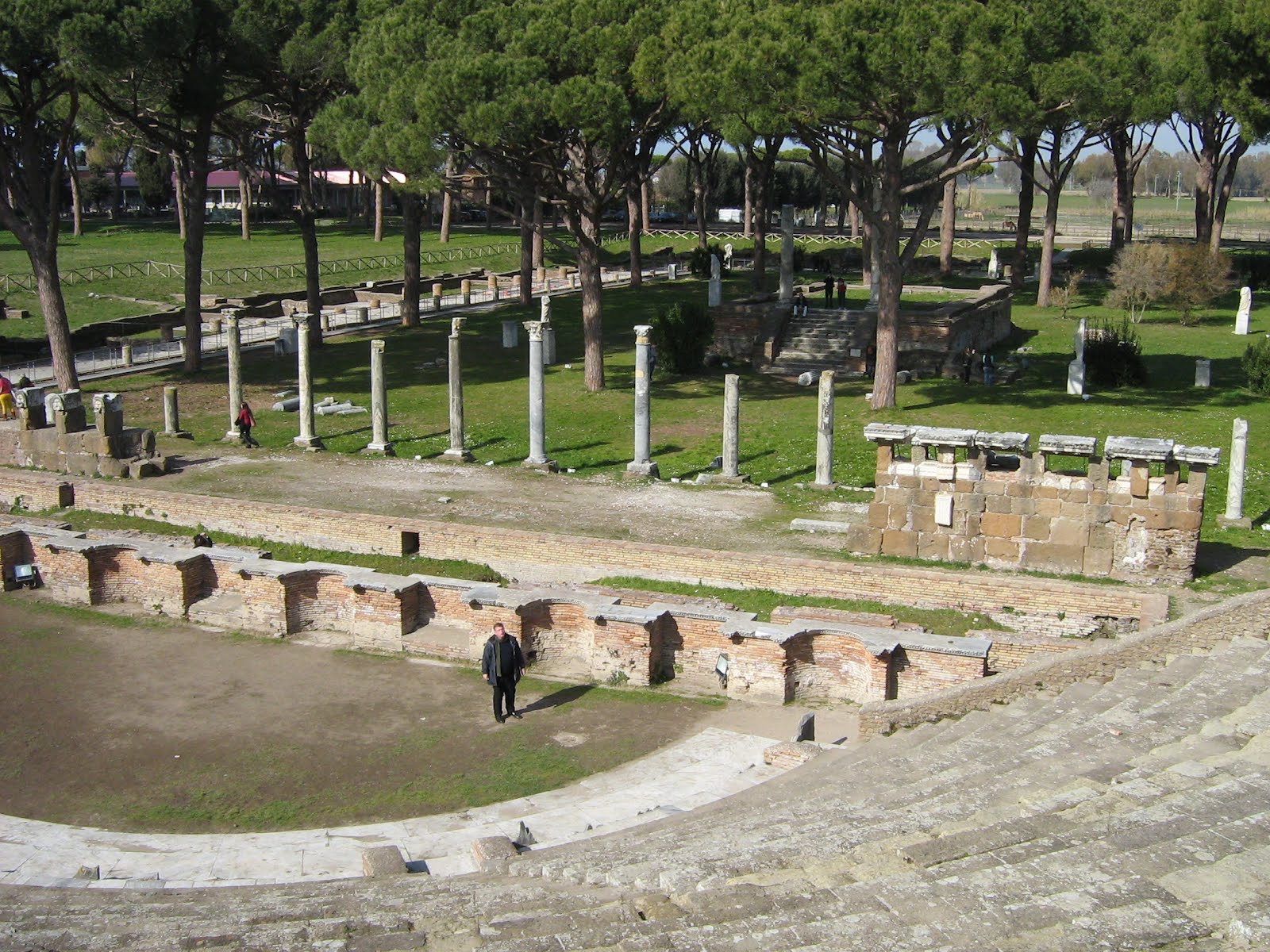
Ostia began life as Rome's port and the most wonderful town now survives with some houses/shops extant up to three stories high. You enter the site down the Avenue of Tombs which leads to the theatre. Part way along I asked Oliver whether the bits of broken pot and tile that we were walking over were actually Roman and passed him a larger bit that I'd just found; he confirmed that it was, indeed, a sherd of 1st century Roman pot which led to everyone walking with their eyes fixed to the ground for the next few minutes! But the architecture was so good that you couldn't look down for long. After Oliver had demonstrated the acoustics in the theatre we looked round the market you can see behind it in the photo, where the shipping merchants had their shops - with mosaics on the floor outside to show the wares they imported (see the photos in the album link on the right). I couldn't really believe that these mosaics were still in the open, unprotected from the elements, it's great.

We saw a bar with a beer garden however, as it was over 1800 years old, unfortunately it was closed. But the highlight of my day (and up there with the Pantheon as experience of the week for me) came just before lunch when we reached the forum and, just along from it was a bath house and opposite that... using the water from the baths for flushing... was a public latrine. Look at it! It even had marble seats! Admittedly a bit chilly in winter and up on Hadrian's Wall you'd definitely rather risk a splinter from a wooden loo seat, but I bet it was nice and cooling in summer or if you'd eaten a dodgy botulus! It even had a marble sink. Oooo, the perfect way to end our holiday! If you've been watching Mary Beard's BBC2 series you'll have seen her sitting on the very same loo.

Basically, we loved Rome and can't wait to go back. In the meantime, I brought back a more authentic carbonara recipe than the one I put on here a couple of years ago:

6oz pasta
2 egg yolks
4oz chopped pancetta or streaky bacon
3 tablespoons cheese (parmesan, pecorino or paduano)
lots of black pepper
Cook the pasta and drain. In the pan fry the bacon in butter. When it's cooked add the pasta to the pan and stir to re-heat. Beat the cheese, pepper and eggs together. Remove the pan from the heat and stir in the egg/cheese mix. Serve.

Labels: , , , , , , , , , , , , , ,

Wednesday, April 27, 2011

Food

I managed to cook several new recipes recently, as per one of my goals that I set at the beginning of the year. In February we had Goulash Soup based on a recipe which first appeared in Delia's Frugal Food back in the '70s. This is a book that I got two of for Christmas, so obviously rumours of my tightwaddery are spreading! I've loved goulash since we first ate it in a Hungarian restaurant in Ross-on-Wye almost 25 years ago, although one of my favourites was in Prague when it was served in a hollowed out loaf. Anyway, we had goulash soup a couple of times in Austria and Germany, so I thought I'd try cooking it and it was extremely good. I made a couple of changes to the above recipe: I added a carrot, I used pork rather than beef and I added a bit of celery.

March's new recipe was Jamie Oliver's Cheat's Pizza which was great. I seem to recall cooking an similar Elizabeth David pizza base (without yeast) and it came out tasting like pastry, but Jamie's version tasted like a thin pizza dough. Our toppings were ancvhovies, olives and chilli. I've got to say that I've enjoyed watching back-to-back re-runs of his Jamie's 30-Minute Meals on Sunday afternoons whilst I've been doing the ironing. I may have to invest in the book.

April's new recipe was Simon Hopkinson's version of Janssen's Temptation from Week in Week Out, but this one by Jane Grigson isn't too different.

Instead of going to Syria we went to one of our favourite hotels, Northcote Manor in Devon. This time in Jon's Dad's MX5 rather than George's Morgan - one day we'll go in our own car! The food was as wondeful as last time. And for my birthday we're off to At the Sign of the Angel in Lacock. I can't believe that we've lived 5 miles away for 22 years and have never been there yet - I hope I'm not disappointed!

Labels: , , , , , , ,

Sunday, July 04, 2010

Ferrets on Tour

We're just back from taking the motorbikes on a trip to Germany; which entailed going through 5 countries (I did hope we'd go through Luxembourg to make it 6 but we just went round the top of it instead) and travelling 1,620 miles - that's more than my bike has ever done in an entire year before! After putting off doing a bike trip for the last 3 summers because the weather has been so awful, this year we decided to just book it and go whatever the weather did. It worked and after drizzle on the first few days the weather was good for the rest of the holiday - if a bit too hot towards the end!

This shows the danger of getting satellite TV, as we were inspired by Henry Cole's 'World's Greatest Motorcycle Rides' on the Travel Channel. But he did make it look a lot easier than it actually was - probably 'cos he has a camera crew help him navigate! Below is Google Maps' suggested route - I can't say that we stuck to it though. We wanted to do some of the 'Castle Route' and the 'Romantic Route', but also ended up doing bits of the Mosel Wine Route and the Nibelung-Sigefried Route too. You know the Germans - they even organise their tourists! Reviews of all the hotels we stayed in can be found on Trip Advisor, well, if they publish some of the rather more scathing ones that is...


View German Trip June 2010 in a larger map

Day -1 - Friday night

We decided to break the journey to Dover by staying in the Premier Inn at Slough on the Friday night. I now heartily agree with John Betjeman's assessment of the place and it's down there with Croydon as one of the most charmless places I've ever been to. It started to rain as we got stuck in the one-way system whilst following the, frankly rubbish, directions from the hotel's website. This set the tone for journey, as we knew every day when we were nearing our destination because it would either start raining or there'd be a road diversion that would add at least half an hour to our journey! I think June must be national road works month in Germany.

Day 1 - Saturday

This stop-over roughly halved our journey to Dover, so we had plenty of time to get there on Saturday and didn't have to rush or worry about getting lost. The ferries now have proper motorcycle parking bays, which is a great innovation since we last travelled to France. They used to just lash the bike to the wall of the car deck, using a manky bit of foam to protect the bike's paintwork from the ropes. If you were lucky a member of staff would do this for you, but you were on your own once you'd docked. Now you drive through a ramp into a metal thingie that grips your front wheel whilst it's strapped down using the back frame. Staff insist on doing this and undoing it once we docked.

Our first destination on the Continent was the Pomme D'Or in Oudenaarde, Belgium. This was a bit ambitious but should have been easily do-able in a reasonable amount of time. But the cross-winds on leaving Calais and heading up to Dunkirk were extraordinary, and after an hour or so of counter-steering (and diversions) I couldn't hold the bike up any more and we had to find a different route. So we dropped down to Wipers/Ypres/Ieper and across country. It was very affecting driving past little knots of graves in tiny graveyards by the side of the road, all beautifully tended by the War Graves Commission - and the names themselves: 'Tyne Cot' Cemetery, 'Irish Farm' Cemetery and 'Colne Valley' Cemetery are so evocative of the groups of men from a single town or borough who joined up together and all too often died together. The sheer number of these graveyards in the Ieper area (the Western Front) is just as awful (in the true sense of the word) as the acres of graves in one single place at the Menin Gate.

Anyway, the diversion added several hours to our journey and we reached the Pomme D'Or at 9pm tired and rather grumpy. But the hotel was lovely and even had a decanter of port in the room - free! - which was extremely welcome. It has a lovely brasserie attached and a very elegant restaurant. Unfortunately, as it was raining, we couldn't go out onto the terrace bar, but we enjoyed the food and Belgian beers in the brasserie. It was such a great place that we were sad to only stay for one night.

Day 2 - Sunday

The next destination was the Ibis in Aachen (Aix-la-Chapelle), Germany. If you're trying to remember why you've heard of Aachen, it was the site of Charlemagne's main palace, there was a treaty signed here at the end of the Napoleonic Wars and it was the first German town to be captured by the Allies in WW2. Oh, and there's a link to Chippenham too, as Alfred the Great's father was born there!

We got horribly lost in Aachen trying to find the hotel (actually, we got horribly lost trying to get out of Belgium too! We were so grateful to the van driver who stopped to help us when we had the map out) - my fault I'm afraid - but finally landed about 4pm. All Ibis hotels are pretty standard, but I really liked this one, it looked out over trees and one of the city's old entrance gates was in the road just below it. Luckily, the cathedral is open 'til 7pm, so plenty of time for late sight-seeing.

Days 3 & 4 - Monday & Tuesday

The next day we headed for the Ibis in Heidelberg, for two nights this time. I've got to say that on the whole German drivers were very considerate to us poor lost bikers, who were probably more like mobile chicanes! The proximity to the Nurburgring meant that there were some fast cars around. Oh, and for any Top Gear fans, Germany is full of Dacia Sanderos. We decided today to get off the autobahn and take the A9 which runs down the Rhine (as recommended by someone at work who'd been stationed out there) and it was such a great road. We stopped at Boppard for lunch (Gulaschsuppe (Goulash Soup) our favourite!), but could have stopped anywhere en-route as there were such beautiful castles and towns by the road that you wanted to stop and take pictures, but there were just so many of them that you'd never get anywhere! There were also vines growing everywhere, not just on fields by the side of the road but on almost vertical hills above the road too. That was quite a long run (more getting lost). But we did find some lovely 'biking' roads that were virtually empty. We found all week that many roads were really quiet and even on A-roads we could be the only things going in our direction for miles at a stretch.

Jon's huge SchnitzelAgain it was about 9pm by the time we were out of the hotel and looking for food; which was found in Zapata's next door to the hotel - Jon made the mistake of going for the special offer on the schnitzel. The restaurant had a South American theme, hence the name, so they had Argentinian beef on the menu - not that Germany doesn't produce plenty of its own, as we could smell the bi-products on the way down! All I can say is that the Germans use a lot of natural fertilisers on their fields.

The next day we used the excellent public transport system to get to Hiedelberg Castle - there's a funicular railway to get up there! Wooo Wooo Wooo!!!! There's an apothecary museum, which was very interesting as there was laudanum, cocaine and absinthe; and that was just in the café! ;¬) The castle is also home to the Heidelberg Tun, a huge barrel that was scorned by Mark Twaine in 'A Tramp The Heidelberg Tun and usAbroad', "Everybody has heard of the great Heidelberg Tun, and most people have seen it, no doubt. It is a wine-cask as big as a cottage, and some traditions say it holds eighteen hundred thousand bottles, and other traditions say it holds eighteen hundred million barrels. I think it likely that one of these statements is a mistake, and the other is a lie. However, the mere matter of capacity is a thing of no sort of consequence, since the cask is empty, and indeed has always been empty, history says. An empty cask the size of a cathedral could excite but little emotion in me. I do not see any wisdom in building a monster cask to hoard up emptiness in, when you can get a better quality, outside, any day, free of expense".

The old town was also lovely. This is going to sound a bit odd, but one result of us bombing the crap out of nice German towns during the war is that it gave the churches the chance to invest in some really innovative stained glass in the post war period. We saw some lovely windows in the Franciscan church in Rothenburg and saw this in Heidelberg.

A real find was the restaurant in the garden that the Kurpfalzisches Museum in the Old Town - and that the western regions of Germany do flammkuchen like they make it in Strasbourg... mmmm, delish. The garden was really quiet and the restaurant not expensive and open 'til 11pm.

Days 5 & 6 - Wednesday and Thursday

The next day we set off to Rothenburg ob der Tauber. We used the autobahn until Bad Wimpfen, were we stopped to do a bit of sight seeing. Actually, you could stop in any small town along the route and you'd see half-timbered mediaeval quaintness a-plenty, it seemed quite difficult to find an ugly town in this region! We saw some amazing birds of prey whilst riding along. They were about the same size as buzzards but flew lower than buzzards do, one flew along side us in the field for a hundred yards or so, whilst another time one flew along in front of Jon.

Then we took the the pretty roads to Rothenburg, which included the customary diversions dictated by road works and us getting lost. Riding into Rothenburg on cobbles through the tower pictured above was amazing - like riding into a mediaeval theme park. I'm glad that I didn't have to tackle those cobbles in the wet. I don't think I've ever been in a town which is still so completely within its mediaeval walls. Bits of the town are closed to traffic during the day, but luckily vehicles going to and from the hotels are exempt from those rules. It's a shame that the 'welcome' we got in the hotel spolied the entire holiday for me. Read about it on Trip Advisor, if the review is still there, because the owner has already had my review removed from the website we booked it through!

That's what I call a still-lifeThe covered town walls were fantastic, sorry if you get bored of all the photos of them in the album. There were lots of churches to look round but we didn't get chance to do the museums because the town itself was just so wonderful to wander around. They even brew their own beers... Which were available at the Gerhaus Hotel. The venison goulash and the flamm at the Reichs Kutchenmeister were scrummy.

Day 7 - Friday

Our way our of Rothenberg
We left Rothenberg via the Klingentor gate (pictured right) and headed off on the pretty roads back to Worms and ran into diversions immediately! This led to us getting very lost in the middle of nowhere, but the Germans were so unfailingly helpful (even on occasions when we didn't actually need help!) that a young girl stopped her car to give us directions. That set us on the right path and we were in Worms for about 4pm. I've got to say that German road signs were rubbish, with towns appearing and disappearing from them seemingly at random!

Worms is one of the oldest cities in Germany and is famous to every spotty school child for its Diet. In 1521 the Diet of Worms declared Martin Luther an outlaw because he would not recant his religious beliefs - there's a very large statue of him in one of the little parks. William Tyndale's first complete edition of the New Testament in English was also printed in Worms in 1526. We were rather unimpressed by Worms, but perhaps we didn't find the nice bit! We visited the cathedral but couldn't find anything else nice to look round, but it is difficult when you've only got a few hours in a town. But we found a good restaurant and a nice bar (Cafe Pinel).

Day 8 - Saturday

We headed off for Bitburg, where the beer comes from. They do tours of the brewery, but we didn't have the time unfortunately. This was quite close to the Nurburgring so again there were some interesting cars and bikes around. There were lots of twisty roads on the way there, which Jon loved, but me less so and not helped by coming across the most ignorant road-users of the week: a group of about 8 British lads on sports bikes who overtook us and lots of other traffic on a series of blind hairpin bends down a steep hill. In fact, one of them almost didn't make it back in in time near me and I thought I was going to be spending the rest of the day scraping bits of him off my leathers and explaining to the German police that this tw*t may have been English but was nothing to do with us.

Day 9 - Sunday

We skirted the top of Luxembourg and made our way back into Belgium. Immediately the driving became somehow more, well, French (apologies to our French friends), with tail-gating and cars overtaking a line of stationary traffic in the face of on-coming traffic! As it was a Sunday there were shoals of lycra-clad cyclists three abreast across the road, it was like being in "Belleville Rendez-vous". There were lots of vintage cars, obviously on a rally, as well as a group of identical BMW Minis all hunting for petrol. Because, of course, this was France/Belgium on a Sunday and everywhere was closed, including the petrol stations. We've had this on previous trips and should have remembered to fill up the day before, but in Britain we get so used to a 24/7 culture that you just forget that our neighbours aren't the same. There were thousands of bikers on the road and when you did go past a petrol station that was open it was packed with bikers chatting and admiring each other's machines. Very sociable.

Chateau de NamurOur destination was the Chateau de Namur, a very posh-looking establishment on the hill above the Citadel. We approached it up a steep cobbled switchback road that led to the Citadel - everywhere we went this holiday seemed to have cobbles and hairpin bends! It turned out to be rather too quirky but the food was excellent. It was too far from the centre of Namur (and far too hot at 30 degrees c) to do sight-seeing, but I think the town would repay a visit, it looked interesting.

Day 10 - Monday

Today was a run up to the Ibis in St Omer, only about 30 miles from Calais, so a nice overnight stop within hailing distance of the ferry. We'd barely seen any Brits all holiday, so it was a bit of a shock to find that seemingly everyone in St Omer was British! Those that weren't were obviously also doing a stop-over before catching the ferry. All the English speaking people we'd heard in Germany were American - there were thousands of them! Rothenburg was packed with them. But there were quite a few US bases around so I wondered if some were visiting relatives or re-visiting old haunts.

Anyway, St Omer was very nice, with a cathedral built of brilliant white stone (well, half of it was, as it's in the process of being cleaned!). Inside, what we at first thought was a housemartin flying near the roof actually turned out to be a bat! Bats in the belfry indeed... We avoided the bars with names like "The Queen Victoria", "Dickens" and "Le Penalty" but had the 16 euro menu at Le P'tit Montmartre, whose chef must have Michelin pretentions as the food was fantastically presented for something at that price. Sadly, no air-con in the bedroom and it was baking!

Day 11 - Tuesday - Home

A very quiet crossing with few vehicles on the ferry. Made it back from Dover in 4 hours and that included a tea break. There was an accident at our M4 junction so we got off at Wootton Bassett and came home via Sutton Benger. It was a lovely run with very little traffic and we were really glad to have such a nice ride so close to home.

It was a difficult holiday with the getting lost becoming very wearing. I think next time we might go less far and spend two nights at more places rather than moving on most days, as the 2 stints of two nights spent at Heidelberg and Rothenberg were more relaxing. But Germany and the Germans were lovely and we'd love to go back.

But we must have slipped into an alternate universe on the ferry home 'cos we got back to find the Conservatives saying that we should send fewer people to prison and use more community sentences. What happened? They've gone left at a speed that makes New Labour's 1995 move to the right look positively pedestrian. They'll be digging up Disraeli and bringing back One Nation Toryism next and then I'll have to vote for them! (Only joking - Satan will have to buy ice skates first).

Labels: , , , , ,