Tuesday, March 17, 2015

Dorset Dalliance

Taking a break from decorating (dining room done, living room scheduled in for Easter weekend) we spent last weekend in Dorset. We were booked in to look around some archaeological stuff with Devizes Museum on Saturday and, as we didn’t want to get up at the crack of crow-sh!t on a Saturday morning we thought we’d use the trip as an excuse to make a weekend of it (you may remember that we went to Wroughton with them in 2011).

The weather was due to be awful but it really brightened up on Friday and by the time we left work it was actually sunny. First stop was the Sixpenny Brewery at Manor Farm in Sixpenny Handley. Their ‘pub’ which doubles as the off-sales office has very restricted opening hours – closing at 6.30 on a Friday evening – would we be able to find it? Would it really be open? As we couldn’t imagine much passing trade in this area of the country so we thought the opening hours might be more erratic than those published. But we arrived in good time just before 6 and was it ever open; the farmyard was packed with cars and people coming and going all the time. I managed to squeeze into a gap next to a barn and we grabbed gloves and mufflers before tottering off to the ‘nano-bar’ - their very accurate description not ours – I think they must have used a fisheye lens for the photo on the website ‘cos it looks 3 times the size of the actual bar!

After fighting our way through the crowded bar we stood outside with our beers. It was the most gorgeous crisp and clear (and freezing) March evening – we could have done with grabbing our coats as well as the gloves and mufflers. We could hardly wipe the grins off our faces as it really was an idyllic setting (well, as idyllic as any working farmyard can be on a lovely evening with a pint in your hand). We’d come well prepared so Jon filled up our bottle basket with take-outs for sampling next weekend at home (luckily they do 6 brews and our bottle basket has six spaces) and we returned to the car (with envious men making sotto voce comments as we passed like ‘That’s what I call a shopping trip!’).

Then off down the road to our hotel, the Castleman at Chettle. A lovely country house hotel with rooms that only cost the same as the ones in the pubs in the surrounding villages. In fact our room was so big – even with the sofa at the end of the bed in front of the fireplace the room didn’t look cramped or over-stuffed - that we thought we’d been put in one of the large doubles by mistake but no, they were all like that.

The lovely panelled bar and the lounge did have cosy fires burning all the time, but it’s definitely a real country house (still owned and run by the family) rather than a sanitized corporate makeover so putting an extra layer on before going downstairs was a good idea. I do hope we find the opportunity to go back sometime because the food was great and the hospitality unfaultable.

The core of the building is possibly Tudor but most of the bits you see now were built in the 1700s or later. The staircase was great and one of the overmantels was very good. I don’t want to get too feudal or deferential about this but it is a bit amazing for us lower middle class types who were brought up, and still live, in modern boxes to have the chance to stay fleetingly in the type of houses that we usually pay the National Trust to be able to wander around for an hour on a Sunday afternoon. To be able to spend as much time as I wanted in front of the Jacobean fireplace (not as much time as I should have spent) or sitting in the Georgian lounge with plasterwork so delicate it might have been on a Wedgewood vase is very special. Someone has a good eye for 20th century art because, whilst most of the paintings looked like old family pieces, the Jessica Brown still lifes in the dining room and the small (alabaster? marble? I’m not very good on stones!) horse in the lounge were lovely (I really should have asked who’d done it).

Anyway, Saturday was a trip back to Sixpenny Handley to see farmer/archaeologist Martin Green’s museum and some of the excavations he’d undertaken on his land. The weather was beautiful when we went into the museum but, sadly, grey and blustery when we came out to start our walk around Martin’s reconstructed excavations – and there’s not much to stop the wind whipping across the Cranborne Chase! If anyone is interested there are details of a couple of things we saw, the pond barrow and the shaft at http://digitaldigging.net/cranborne-chase-archaeology/. The shaft is amazing – Martin got 13 metres down it before being stopped by the water table, but it’s been augured to be twice as deep. It can now be viewed from a bridge above and we can confirm that it’s definitely a bloody big hole

Lunch at the Inn at Cranborne then off to the Ancient Technology Centre. We’d been to a lecture at Devizes Museum by Luke Winter just before Christmas that was brill and he was just as informative and funny showing us around the reconstructions on site. It’s an experimental archaeology centre where they try to recreate ancient buildings using ancient techniques and materials but using children to do the work. It’s fascinating; with a reconstructed Viking longhouse, Isle of Man earthhouse, Iron Age roundhouse, Roman forge and more, recreated from the archaeological evidence. Most children come to visit on a regular basis to help with the builds, but when groups of children come to stay overnight in the longhouse they have to butcher their own meat, make bread, chop vegetables and cook on the open firepit – they claim never to have lost a child, or a bit of a child, yet (but many parents must still send theirs’ along in hope…)!

If you like Time Team you may remember the Special in which they recreated a Roman water wheel based on pieces that had been excavated in London at the start of the millennium. The Museum of London donated it to the ACT so many of our group had fun trying it out!

Then back to the hotel for a beer and a soak in the bath to get the smell of wood smoke out before dinner. All-in-all a brilliant way to spend a weekend.

Devizes Museum put on a great range of lectures and events throughout the year, details of which can be found here.

Labels: , , , , , , ,

Tuesday, April 22, 2014

Athens

We spent February half-term week in Athens - 20c and sunny, in case you were going to ask, which was much nicer than grey and wet Wiltshire. The perfect weather and temperature for serious sight-seeing. We went with Andante again who put us up in the Herodion Hotel

which really did have this view of the Acropolis from the roof terrace, with a view into the Acropolis Museum on the other side. It was a very well located hotel, handy for many of the sights and for the restaurants in the Plaka, plus it had an excellent little bistro/bar for when we were just too knackered to make it back out at night!

Day 1

We walked up the Acropolis hill, past the Theatre of Dionysus (5th century BC or earlier) and the Odeion of Herodes Atticus (theatre 2nd cent. AD). The views over Athens and up at the protective walls of the Acropolis were stunning. I loved the green spaces around some sides of the hill which then give way to remnants of the old town clustering close to the Acropolis, seemingly for protection.

The Acropolis still dominates the city, as it has since at least 1400BC when the Mycenaeans built a palace there. It's such a great defensive and ostentatious site that successive inhabitants must have been drawn there from the earliest times. In the 6th cent. BC temples, treasuries and a formal entrance (Propylaia) were built but were destroyed when the Persians attacked in 480BC. Rather than rebuild immediately, the Athenians chose to bury the sculpture and use the stones from temple columns and walls in strengthening the defences - these massive column drums can still be seen in the walls that surround the Acropolis today.

The Athenians rebuilt the temples on the Acropolis between 447 and 406BC. The largest and most iconic is the Parthenon but it is possible that the Erechtheion was the most important to contemporary residents, and had been for along time as it contained the original 'statue' of Athena - Mary Beard says that by the 440s BC it was, "...little more than an olive-wood plank...Its sacred status came...from its extreme antiquity"*. The Temple of Nike (Athena as Victory) and the Propylaia were also re-built at this time. The trip to the Acropolis proved the wisdom of visiting at this time of year. During busier holiday periods it is just crammed with people - I know 'cos I was there nearly 30 years ago in August - but there were few large groups up there with us and, if you waited a short while, almost any view would clear of people long enough to take a photograph or get a better perspective. I think that the crane inside the Parthenon is the same one that I saw in 1986, but the scaffolding has moved around a bit!

After lunch - we chose cheese or spinach pies most days (sublime!) - we visited the Greek Agora, the civic heart of the ancient city. Along one end of it is the Stoa of Attalos (a covered walk-way which would have had a range of uses) that has been restored and now houses a sweet little two storey museum and storage rooms for finds. But one of the main reasons to visit the Agora is to see the Hephaisteion, a very well preserved 5th cent. BC temple which gives a good idea of what the Parthenon would have looked like. Like many ancient buildings that have survived into modern times, it survived because it was taken over by the early Christians - OK they did have a tendency to deface sculptures and carve their own images over things they didn't like, but at least most of the building survived!

Day 2

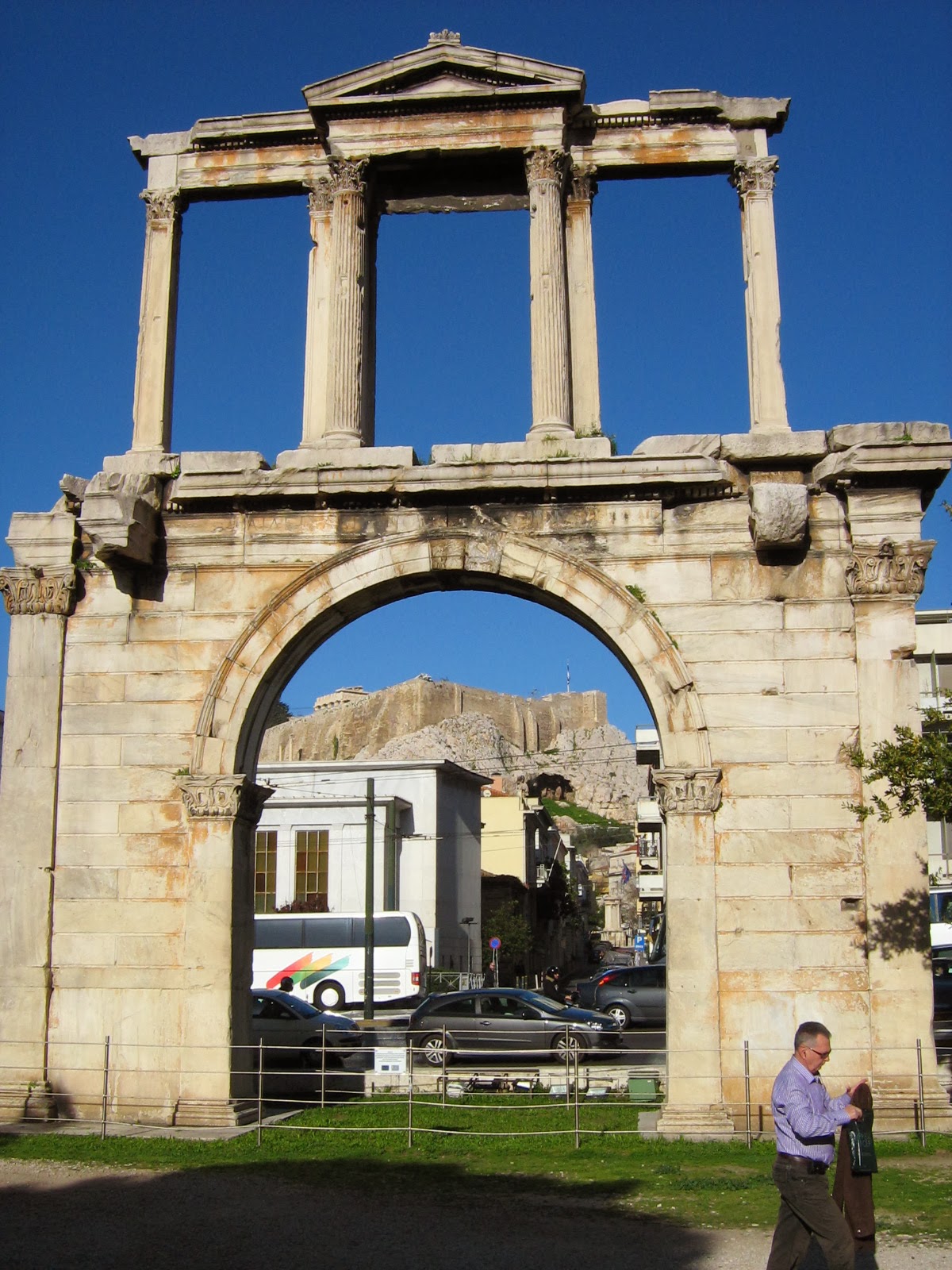
Some of the intended visits had to be re-jigged because of 'winter opening hours' and ad hoc strikes. I would humbly suggest that a country that's economically stuffed would do better to keep their monuments open beyond 3pm to screw as much money out of tourists as possible. We started today with Hadrian’s Arch - by the side of a road so no chance of that being closed! But a planned visit to the Kerameikos district had to be shelved because of strike. I think that the Greek tour guide who accompanied the Andante guide was quite embarrassed at the negative impression she thought the strikes were giving us of her country, and I don't think she was consoled by one of the older members of our party exclaiming, "It's Greece, we expected it!".
Instead we had a brilliant walk around the flea market in the Monastiraki district, culminating in the fantastic little Panagia Gorgoupekous - Agia Eleftherios church on Mitropoleos Square. It's a 12th cent. church but the builders re-used all sorts of sculpture, pediments and cornices from earlier buildings completely out of context and with no knowledge of architectural conventions (a triangular pediment floats in a wall nowhere near a door), which makes it fascinating to walk round. Scenes were often 'Christianized' by simply adding a cross between the images. A really lovely little place.

Then off to the Library of Hadrian, which we were surprised to find was full of tortoises! We'd spotted one yesterday as we'd walked past the entrance and hadn't quite believed our eyes, but at least 5 of them were charging around - and they really can move pretty quickly too. Lunch was at the new Acropolis Museum (which we could see into from our hotel - very nice when it's lit at night and you can see the sculptures from our hotel's roof terrace), followed by a tour.
It's nice to get up close to sculpture that would once have been high on a building, oh, and the original caryatids from the Erechtheion on the Acropolis (the girlies who hold the roof up with their heads) are there too. I always like to see the bits of original paint on all these statues and bits of architecture - I think we'd have been shocked to see these statues, that have come down to us as pure white marble, in their original gaudily painted state.

Jon took the guided walk to the Pnyx (a rocky hillside where the council of Athens used to meet in the 6th cent. BC) whilst I went and put my feet up!

Day 3

Today we had a coach trip north out of the city to the sanctuary of Apollo at Delphi, in a wonderfully dramatic mountain terrace setting. I don't think any of us had realised that Greece had a skiing region so we were rather surprised to find that Mount Parnassus had a snow-sports resort. Unfortunately, the bad weather that had been depositing rain on the UK from December to February had not been falling as snow in Greece, so I think trade was a little thin, but it was quite surreal to drive past alpine-style chalets and through towns stuffed with ski/snowboarding shops. As we drove past trees whose pink and white blossoms were coming out, with the snow-capped mountain in the background, it all looked rather Japanese.

Delphi was thought to have been the 'belly-button of the world' by the ancient Greeks (an 'outie' rather than an 'innie' if the stone at the site is anything to go by!) and seems to have been the site of an important oracle from as early as the 1400s BC. The oracle or prophecies were delivered by a priestess, who sat on some sort of tripod over a chasm in the inner sanctum of the temple. It is thought that she inhaled the gases which came up from this volcanic region and then delivered the prophecies in a trance. Every four years Delphi also held the second most important of the series of four Panhellenic games that the modern Olympics are based on (the other 3 being held at Olympia, Nemea and Isthmia).

These ancients certainly knew how to pick a picturesque spot. Delphi is simply stunning and well worth a trip just to look at the view - in fact I was so busy goggling at the view that I almost missed the theatre in this photo that was right behind me! It's a rather vertiguous site though and is quite a climb from the entrance at the bottom to the stadium at the top. I'd hate to do that climb in the heat of summer when it's rammed with parties of school kids and you can't even fit a fag-paper between the tourists. The small on-site museum holds some of the best items that have been discovered at Delphi, including the charioteer, but I was fascinated by some tiny but beautifully carved ivory figures hardly an inch high; as well as the painted stonework from the temples and a style of column that I'd not seen before. As usual, photos are in the gallery on the right =>

On the way back to Athens we stopped off at the Byzantine monastery and World Heritage Site of Hosios Luscas. The monastery was founded in the late 900s AD in a beautiful setting on Mount Helikon and is dedicated to St Luke of Steiris who died in 946AD - he, or rather his 'relics', now lives in a glass box to the right as you enter the church. The outside of the buildings were gorgeous but the mosaics and frescos inside were simply stunning; I'm always amazed that such things can survive over a thousand years of earthquakes, wars and redecoration. Sadly my camera couldn't do them justice and it was a little disappointing to see relatively inexpensive 'phones capturing much better images than my 8 year old Canon Powershot. Once again I thought that I may have to upgrade...

Day 4

The morning was spent having a quick guided tour of the National Archaeological Museum in Athens, with one of the finest collections in the world we decided that a morning wasn't enough so we had lunch and then explored it on our own. I'd spotted what appeared to be a temporary exhibition bringing together all the finds from the Antikythera shipwreck into one space (they're usually spread around different rooms of the museum) so I was desperate to see it - sorry, I am that boring, 'desperate' was not an exaggeration! The wreck was discovered by sponge drivers off the coast of the Aegean island of Antikythera in 1900. It appears to have sunk in around 70BC and was carrying a treasure trove of some of the best Greek art of the previous 400 years, leading archaeologists to believe that it was taking art looted by the Roman General Sulla back to Julius Caesar in Italy. Again, I'm stunned that such delicate glasswork survived intact for over 2000 years and I loved the contrast in decay between a bit of a sculpture that had been buried in the sea bed and the part that had been exposed to the sea.

But the highlight was a series of corroded bronze lumps made up of various cogs and gears which formed what's become known as the Antikythera mechanism, or 'the world's oldest computer'. It took archaeologists and engineers the best part of 100 years to analyse it and the exhibition has various examples of that they think it would have looked like. It's a fascinating and complex piece of equipment that seemed designed to predict astronomical events, eclipses and other data relevant to the ancient Greeks, such as the date of various Olympiads. Although one might think that it was designed as a navigational aid (especially as it is transportable and appears to have its own instruction manual) it looks like it was part of the loot, as the metal would not have stood up to the corrosive salt-laden atmosphere and it seems to have too much unnecessary data. This object does not seem to have been rare in the classical Greek-speaking world but, although some elements of this ancient technology were preserved by the Byzantine and Islamic cultures after the fall of the Roman empire and later travelled back into Europe via the writings of Islamic scholars, it took over one thousand four hundred years for anyone in the west to create anything using a geared or clockwork mechanism - and these first mechanical clocks were still much simpler than the Antikythera mechanism. If you have even a small element of geekiness about you
(either archaeological or technological) keep your eye open for BBC Four's brilliant 'The two-thousand-year-old computer' which pops up every few months and tells the fascinating story of the decoding of these corroded bronze lumps.

There are such treasures here, like the Cycladic figurines which influenced the 20th century modern artists, but a day wasn't enough.

Jon took the guided walk to the Philopappos Monument whilst I, again, put my feet up. This is an ancient mausoleum dating to about 116AD on the top of Mouseion Hill which gives stunning views over the Acropolis and the city.

Day 5

We managed to fit in a quick visit to Kerameikos (area of the potters) which had been closed the other day due to a strike. This was the most important cemetery in ancient Athens but also had the Dipylon Gate which was the favourite entrance to the city and led to Plato's academy, and the Sacred Gate which led to Eleusis. The rich lined these two roads with lavish tombs until such extravagance was outlawed in the 300s BC when only small columns were allowed as grave markers although, strangely, some people still managed to have bigger columns than others... There's a cracking little museum which, as well as the usual marble statues, has some really interesting everyday items like make-up boxes with face-powder and other tints still inside.

Then onto Attica to the stunningly situated Sanctuary of Athena Sounias and Temple of Poseidon on a headland at Sounion. Lord Byron carved his name on the temple in 1810 - when I visited 30 years ago you were allowed into the temple and up to the column that he graffitied, so close that you could actually touch it (although I just took a photo instead, honest), but now you have to keep a respectful distance. There were lots of other graffitied blocks to photograph this time!

On to the ruined ancient city of Thorikos, famous for its silver mines, on which the Athenian economy depended - 20,000 slaves were employed at its height. This was the sort of place that we come on specialist archaeological tours to visit, no-one else was there for the entirety of our visit, so, well off the beaten track so to speak, even though it was at the side of he road and completely free of charge. It has one of the earliest surviving theatres in Greece, which is also an unusual rectangular shape. There is a restored ore-dressing and washing floor next to the entry to one of the mines. Again, it's a lovely spot and all the spring flowers were in full bloom. I was thrilled to find a bit of graffiti from a Soviet sailor who must have docked at the port we could see just across the bay in 1972 - he even drew a picture of his trawler!

It was a great trip and a really beautiful time of year to visit. We've visited Rome and Athens now in February and it does seem to be a great time to go: few tourists, lovely (if very cold in Rome) weather and very relaxed. All photos will be uploaded to the album asap.


* The Parthenon, Mary Beard, Harvard Uni Press, 2003, p.147

Labels: , , , , , ,

Friday, February 14, 2014

Friday Fun 19

We're off to Athens soon, so I thought this might help with my fear of flying, or pehaps not... I think Dean Martin corpsing is almost the funniest thing.

Labels: , ,

Tuesday, April 24, 2012

Arrivederci Roma

We're recently back from a week in the 'Eternal City' having finally managed to go away with the company that we've been trying to go to Syria with for the last year. After looking forward to a trip for so long we were a bit worried that we might be disappointed but we had a fantastic time. Our guide, Oliver, is a proper working archaeologist and was brilliant - knowledgeable, approachable, flexible.
We thought that the Ferret Holiday Curse had struck again because, as well as the Italian economy being f**ked, it snowed in Rome for the first time in over twenty years the week before we arrived! They even closed the Colosseum to visitors on health and safety grounds (yes, who knew that they have health and safety on the continent?). I'm not sure that this picture actually shows just how cold it was at 9am!

We took our own flights from Brizzle 'cos we couldn't be bothered trying to get to Gatwick - life's too short. Luckily, our flight arrived only 20 mins after the main group's did and we spotted them in the arrivals hall which meant that we were able to get a lift in the coach rather than having to find our own way to the hotel - admittedly that wouldn't have been difficult, but it was nice to meet Oliver and the rest of the group early on.

The hotel, Pace Helvezia, was really handy for the Forum and lots of other sites. We liked it but there is some criticism on Trip Advisor of its small bedrooms. Ours was at the back of the hotel, so reasonably quiet for a room in the middle of a busy city, the bedroom size was fine and the bathroom was huge. The public areas did need some updating and the bar was never open, but there are lots of other places to go, who wants to spend the evening in their hotel in Rome? The roof terrace was wonderful and I spent a very happy morning on our 'day off' reading in the sun whilst Jon hired a scooter (yes, he did, and survived!).

We had some lovely dinners, although we had to get used to all our meat arriving looking like it'd been run over, as the Romans seemed to flatten all meat for some reason. Oh, and you've got to order your veggies as a side dish. We tried Le Lanterne just over the road from the hotel and I had a fantastic minestrone at La Taverna dei Monti which was bursting with absolutely fresh vegetables and must have been at least 3 of my '5 a day'! We also liked The Glass bar and restaurant just off Piazza Venezia. But we found the drinks everywhere to be really expensive at 5+ Euros for very uninteresting lagers. We finally found the Theatre Café Bar just up the road from our hotel on the roundabout where Via 4 Novembre, Largo Magnanpolis and Via Nazionale meet. The interior has large mirrors with 'Only Bass' on, but sadly no Bass on tap, but they did have Affligem and Erdinger which were cheaper and had more flavour than the gassy local beers. The food was great too - and came with vegetables! We get a bit enthusiastic (greedy) and ordered a starter of antipasti for me and a soup for Jon (which was a proper rustic job, thickened with bread). Then I had a lovely Gateau di Patate which came with a salad and more tiny mozzarella balls than you could shake a stick at and Jon had saltimbocca with lots of roasted peppers and courgettes - which we could hardly finish.

We loved Rome - it was far less intimidating than Naples. In Naples there were streets that I definitely wouldn't have wanted to walk down without being accompanied by someone who knew it was safe, but we didn't find anywhere like that in Rome. All our preconceptions of the traffic, the car horns blaring, etc were completely over-turned, but it may have been because of the time of year we were there as other people have said it's very manic in summer. It did feel rather provincial though; no big theatre district like in London, no fancy cars. On the car front, we saw more Porsches parked in Chippenham town centre at 10.30 on a very quiet Sunday morning when we got home than we'd seen all week in Rome (i.e. two). The locals seemed to go in for large-ish family/executive saloons, especially BMWs and Merc C and E Classes - but no CLS. They often seemed to have a driver which I suppose means that the chauffeured were politicians of some sort (Rome is home to the provincial as well as national government, plus UN buildings, EU offices, etc). We saw a couple of Jag XFs but no larger Jags, Ferraris, Astons or Bentleys, like we usually see on a walk down Piccadilly in London (to be honest, like I see on my commute to work in Bath on a good morning). But, what we did see were 4 Maserati Quattroportes - or possibly just the same two, as they were all police Massers (note the blue lights on this one - there's a second photo in the album on the right) and seemed to be used to carry the more important politicians around. Jealous? Pah!

Day one
Saw us start close to the hotel with Trajan's column (there's a cast of it in the V&A in London if you can't make it to Rome) which was erected in 113AD and tells the story of his victory against the Dacians and the Imperial Forum. Crikey, it was cold! And there was still snow around but the sky was crystal clear and it was beautiful. Down the road we could see the Colosseum - honestly, you can't turn a corner without tripping over archaeology - but we were going across the road to the Forum Romana which is a fascinating jumble of political and religious buildings and monuments. Like the Arch of Titus, pictured here, which commemorates the sack of Jerusalem and depicts Roman soldiers carrying away the menorah and other sacred relics from the Temple. Then up to the Palatine Hill where Rome's elite built their palaces and on which was discovered a hut that
formed part of the earliest Bronze Age settlement. After lunch we headed to the Colosseum but, can you believe it, it was closed for two days whilst they did some assessments after the previous week's bad weather. Our tickets would still be valid later in the week, so instead we went to San Clemente. This is a lovely church run by the Irish Dominicans which contains some exquisite 12th century mosaics. BUT go downstairs and there is the 4th century church with frescos from the 4th-11th centuries. BUT below that are Roman buildings, some with foundations which pre-date the fire of Nero (64AD), the temple of Mithras and 6th century catacombs. These are about 9m below the street level and include drains and springs but Oliver said that in some areas the Roman remains go as deep as 35m. Absolutely fascinating and well worth a visit.

Day Two
We headed out of the city to Hadrian's villa at Tivoli. It was much colder (as this gentleman illustrates) with more snow on the ground and some pools actually had over an inch of ice on them! After lunch we had intended to visit the Villa d'Este (which I was really looking forward to) but unfortunately, as some of the paths are rather precipitous, it was closed due to the ice and snow. So we came back into the city and went to the Capitoline Museum.

As well as holding treasures that you'll have seen thousands of times in reproduction (like this massive statue of Constantine II), it also has a splendid view over the Forum - which was almost empty at that time of the early evening. And, like everywhere else in Rome, it has bits of ancient architecture sticking out occasionally.

Day Three
Was a walk through the Field of Mars, the Stadium of Domitian (now Piazza Navona - the buildings are where the seating would have been but the Piazza preserves the shape of the Stadium), past the column of Marcus Aurelius to the Pantheon. This visit to the Pantheon was what I was most looking forward to and after studying it and seeing pictures and plans for so long I've got to admit that I was a little over-come at standing inside it at last. It is awe-inspiring that it's still the largest unreinforced concrete dome in the world despite being built in 128AD and that the world saw nothing that even came close to it until Brunelleschi got his hands on Florence cathedral in the 1400s. With all works of art and architecture no reproduction in a book does justice to the actual thing itself: the portico is so much deeper than I imagined; the doors and portico roof are the same that were put there almost 2000 years ago; the brightness of the marble interior. One of the few ancient structures to have actually been protected by Christianity rather than destroyed by it.

Then on to the Ara Pacis and the Tomb of Augustus and finishing up at the Trevi Fountain.

Day Four
I spent the morning on the roof terrace reading whilst Jon took a scooter out - yes, that's him heading out into the Roman traffic. He actually went out beyond the city walls to do some exploring and found a quiet little café (espressos were a lot cheaper than inside the walls!). In the afternoon we made our postponed trip to the Colosseum. We got to the front of the queue with our group and found the turnstiles being erratically 'controlled' by this laptop - the password is on the post-it note sellotaped to the keyboard! Just after our group got through it seemed to give up altogether and the turnstiles jammed; there were a lot of disgruntled people in the queue!
After seeing the ice on some of the closed areas I'm not surprised that it was closed for a few days.

Day Five
Was coming home day and there was a trip to Ostia booked in on the way to the airport. The rest of the group had an entire day there but our flights were a little earlier than theirs so we had to leave about 2pm. Very kindly Oliver got the coach to take us rather than us having to get a cab. On the way to Ostia we stopped off at the fascinating but freezing Museo della Civilta Romana in EUR. Yes, it really was built without heating! The wardens were all wearing winter coats and gloves inside and kept nipping to the hot drink vending machines!. Everything here is a copy or a model but it's all great. The architecture in EUR is modernist and I loved it, although it does give you mixed feelings admiring something planned and begun by the fascists, but it was finished by Giovanni Agnelli so I guess that makes it OK!

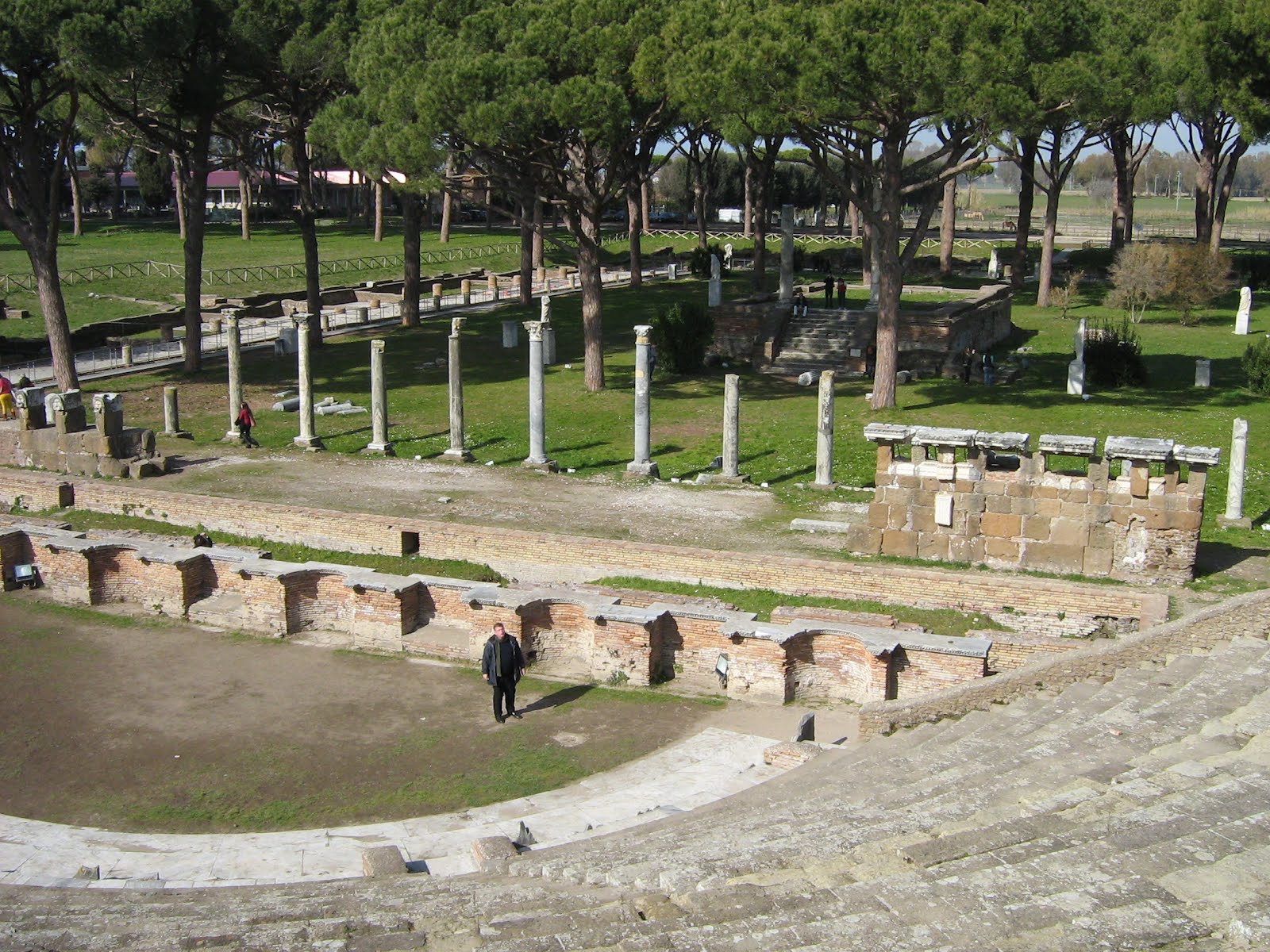
Ostia began life as Rome's port and the most wonderful town now survives with some houses/shops extant up to three stories high. You enter the site down the Avenue of Tombs which leads to the theatre. Part way along I asked Oliver whether the bits of broken pot and tile that we were walking over were actually Roman and passed him a larger bit that I'd just found; he confirmed that it was, indeed, a sherd of 1st century Roman pot which led to everyone walking with their eyes fixed to the ground for the next few minutes! But the architecture was so good that you couldn't look down for long. After Oliver had demonstrated the acoustics in the theatre we looked round the market you can see behind it in the photo, where the shipping merchants had their shops - with mosaics on the floor outside to show the wares they imported (see the photos in the album link on the right). I couldn't really believe that these mosaics were still in the open, unprotected from the elements, it's great.

We saw a bar with a beer garden however, as it was over 1800 years old, unfortunately it was closed. But the highlight of my day (and up there with the Pantheon as experience of the week for me) came just before lunch when we reached the forum and, just along from it was a bath house and opposite that... using the water from the baths for flushing... was a public latrine. Look at it! It even had marble seats! Admittedly a bit chilly in winter and up on Hadrian's Wall you'd definitely rather risk a splinter from a wooden loo seat, but I bet it was nice and cooling in summer or if you'd eaten a dodgy botulus! It even had a marble sink. Oooo, the perfect way to end our holiday! If you've been watching Mary Beard's BBC2 series you'll have seen her sitting on the very same loo.

Basically, we loved Rome and can't wait to go back. In the meantime, I brought back a more authentic carbonara recipe than the one I put on here a couple of years ago:

6oz pasta
2 egg yolks
4oz chopped pancetta or streaky bacon
3 tablespoons cheese (parmesan, pecorino or paduano)
lots of black pepper
Cook the pasta and drain. In the pan fry the bacon in butter. When it's cooked add the pasta to the pan and stir to re-heat. Beat the cheese, pepper and eggs together. Remove the pan from the heat and stir in the egg/cheese mix. Serve.

Labels: , , , , , , , , , , , , , ,

Sunday, January 01, 2012


Festivities

This is where we spent Christmas, Mallory Court in Warwickshire. Dad, Jon and I arrived to afternoon tea on Christmas Eve and left the day after Boxing Day. On Christmas Eve we had a carol concert by the boys and men of St Mary's Collegiate Church in Warwick, which was lovely and included some interesting newer stuff alongside the traditional carols. We were looked after fantastically and loved it, especially the food. Given how much we over-research things, can you believe that we missed the fact that the restaurant was Michelin starred? We began to get an inkling at dinner on Chistmas Eve though! The food was wonderful, but so was the service, the hotel, everything really. I couldn't recommend it high enough - we even got a gift hamper when we arrived and a 'care pack' of water, nibbles, fruit, etc for the journey on leaving. More photos in the photo album on the right. Also managed to nip into Leamington Spa to have a quick look at the sales on Boxing Day!

We've had a nice peaceful uneventful week off work since then. I could really get used to not working for a living! The New Year began with soup making to use up a few things from the freezer and one or two things that were lurking ominously at the back of the 'fridge. I'm typing the recipe here 'cos it's actually an amalgam of several recipes and at least if it's here I'll know where to find it again!

Bacon and lentil Soup
Serves 12 (makes 6 pints) at 22p per 250ml serving (excluding the wine and parsley). Each portion is at least one of your '5 A Day'.

200g lentils (I prefer red, but you can use any)
200g bacon (I prefer to use smoked, but again...) finely chopped, with the fat cut off (leave it out of you just want a vegetarian soup)
2 carrots, peeled and chopped finely
2 medium onions, peeled and chopped finely
2 sticks celery, chopped finely
2 cloves garlic, peeled and crushed
400g tin tomatoes, or 4-6 ripe fresh tomatoes (those at the back of the 'fridge that are about to turn to water...), chopped finely
1 glass red wine (optional)
1 tsp fennel seeds
Half tsp dried ground coriander
Ground black pepper (taste the soup before salting as the bacon and stock will probably make it salty enough)
Pinch Cayenne pepper
3 pints vegetable or chicken stock
2 tbs chopped parsley stirred in to serve (optional).

Put all the ingredients except the parsley in a large pan. Bring to the boil and then turn the heat down and simmer for an hour until the lentils are soft.

Allow it to cool a little and then, if you like a slightly lumpy consistency, liquidize half the soup and return it to the pan. If you like it smooth then liquidize it all. Add more stock or water if the soup is too thick. Reheat and then stir in the parsley just before serving. Can be frozen.

As it's New Year's Day I thought I'd review the goals I set this time last year http://lazyferret.blogspot.com/2011_01_01_archive.html

Goals for 2011:
1. Get more exercise
Nah, was never going to happen was it?
2. Do some track days/driving 'experiences' at local motor racing circuit
No, I must do this in 2012.
3. Cook a new recipe each month
Yes, I think I managed 12 new recipes and posted them throughout the year
4. Get a hair cut - sounds easy but I've always hated going to the hairdressers and the last time I went was Sept 2009!
Yes! And have been several times since. Shocked all my colleagues who hadn't known me with short stripey hair!
5. Worry less
Nah, was never going to happen was it?
6. Sort out a new boiler
Yes, and Michel is great and was blogged about.

I'm not sure I want to set any goals this year. We'll just see how it goes!

Happy 2012!

Labels: , , , ,

Friday, October 28, 2011

Reflections in the cathedral
Vous êtes ici

We're recently back from our second trip to France this year. We spent the week in Le Mans because, after driving through the city on our way to the Circuit de la Sarthe for the 24 hours race a few times, we decided that we'd rather like to see what it looked like. And we can report that it is gorgeous!

We stayed in the Ibis Centre which was very handy for the old town and the tram. As hotel breakfasts are extortionate, we ate instead in various little cafes (for the Le Mans Legend cafebargain-hunters amongst you, we noticed that the Brioche Doree (Rue des Minimes, just off Rue de la Port) had a good breakfast offer - which we didn't try). The restaurants in the old town are a bit more pricey than those off the Place de la Republique - there are some nice little brasseries and pizza places around Republique - but I think that some of the best meals we had were in the old town. Some restaurants we tried were: La Chamade on Rue Doree; Les Trois Sonnettes on Rue des 3 Sonnettes; Le Nez Rouge on Grande Rue (brilliant but you may have to book). We did also have a great pizza in the Le Mans Legend cafe on Rue de la Port amongst all sorts of race memorabilia - well you've got to haven't you?!

Reflections in the cathedralDay one was spent in the cathedral and wandering around the old town and looking at the amazingly intact Roman walls. There's a lovely market in the square below the cathedral on Sunday, Wednesday and Friday mornings so we popped down and got ourselves some fruit. We also picked up a Le Mans City Pass for 10€ from the Tourist Information Office. Roman WallsThis gives free entry into one of the museums plus a 24 hour public transport ticket and half price entry into lots of other museums and attractions. We decided to use our free entry to go to the museum of the 24 hour race out at the circuit 'cos it's the most expensive to get into and would also take us on a tram and a bus so we could use our public transport voucher too.

So, day two was spent at the Circuit de la Sarthe. The tram will only take you so far on non-race days (it will actually take you to the back of the circuit, but there's no way to get round to the front from there if it's a non-race day and the circuit is closed). We then took a bus which dropped us about half a mile from the circuit and we toddled off in search of cars. On the way we passed a bar that we'd last been in about 10 years ago after the 24 hour race. Then it was packed with the drunk and tired of all nations and the only food it had left was croque. Damn fine croque as I recall - although I may just have been tired and hungry at that point! I've got to say that, on that occasion, the bar didn't look like somewhere you'd normally want to spend a lot of time but today, when it wasn't packed with tired and emotional race fans, it looked very nice.

Le Mans 24 hours race museumWe had lunch in the cute little cafe at the circuit museum - you can see some of the exhibits from the cafe too (look over Mr H's shoulder as he downs his lunchtime pression). The museum doesn't just have Le Mans winning cars but includes a 'history of motoring' section which has everything from the earliest steam-powered road vehicles (death-traps on wheels they seemed to me) right through to Minis. Le Mans 24 Hours race museumThen it was into all the iconic Le Mans cars: Bentley, Lagonda, Lotus, GT40, Audi, etc, with a little Porsche exhibition to end. The tourist pass gives half-price entry to the circuit on non-race days so, as we could hear the sound of engines coming from there (someone testing perhaps?) we decided to go and have a look. What we actually found were members of the ACO's 'Passion 24 Club' taking their cars round the Bugatti circuit on a track day. There were some fascinating cars waiting to go on track: some rare French things Le Mans race circuitthat even Mr H had only seen in books and not seen in real life. There were also a gratifying number of British makes: Lotus, Jag, Morgan, MG, Triumph, all French-owned with only a couple of English number plates amongst them. We had a great time; going up into the grandstands; watching from the pit-wall and sticking our heads out of the gaps that they push the pit-boards through on race days. It was worth so much more than the couple of euros each that we'd paid to get in!

Then, as we were coming away from the pits, who should roll up but Vicki Butler-Henderson and a film crew to do a piece to camera before driving the new Ford Mustang round the circuit. Shown on Channel 5 on Friday 21st October 2011 and which I think you can catch online on C5's 'on demand' service. All that and I got to go on a tram as well! That's what I call a good day out.

brass plaqueOf course Le Mans has very strong claims on English sensibilities, and not just because of the 70,000 Brits who invade every June. Geoffrey of Anjou (Plantagenet) married Empress Matilda (daughter of and heir to Henry I of England) in Le Mans and his son Henry (who became Henry II of England) was baptised there. Following the death of Henry's son King Richard I (Cœur de Lion) his widow Berengaria retired to Le Mans. As an aside, Geoffrey of Anjou's mother was Eremburga of La Flèche - the town Chippenham is twinned with. Le Mans itself is twinned with Bolton. Yes, Bolton... What, in the name of all that is holy, possessed them to twin with Bolton? They'd obviously never visited it. However, the Bolton Food Cafe on Rue de Bolton did very nice breakfasts - no black pudding though...

As well as the amazing Roman walls by the river there is a Roman bath house (only open for orgainised visits on Tuesdays booked through the Tourist Information office so we didn't manage to get there) and remnants of Roman wall under the Plantagenet era stonework. The archaeological and history museum Carré Plantagenêt has a great view of the back of the Hotel de Ville and the surviving Plantagenet buildings Notre Dame de la Coutureincorporated into it. In one of the rooms in the museum that has Middle Ages period tombs (pictured above) there was a brilliant animation projected onto the blank walls telling the story of the Plantagenets. In French, of course, so I couldn't understand a bloody word but it was fantastic. We also visited the Musée de Tessé which is the city's fine arts museum. There are one or two little gems in there, but the absolutely bestest thing is that downstairs, as well as displaying all their Egyptian antiquities, they have full-sized reproductions of the tombs of queen Nefertari and an official called Sennefer! They were great and more museums should do things like that. I bet they're very popular for school trips 'cos the little buggers can wander through an almost real Egyptian tomb - something very few of them will ever get to experience.

Notre Dame de la CoutureThe churches we visited were wonderful too. We don't get much Romanesque stuff in Britain so it's really nice to see Romanesque buildings when we go abroad. Although the stonework can seem heavy the light just poured in (mainly because most of the windows didn't have stained glass) and many of them didn't need additional electric lighting. Highlights were Notre Dame de la Couture and Notre Dame du Pre. Notre Dame du Pre was smaller but seemed more original, so it was an interesting contrast to the larger and more central Notre Dame de la Couture which seemed to have been 'mucked about with' (technical architectural term!) a bit more.

bar FlaceauIf you do make it to Le Mans we highly recommend the bar Flaceau. It's down a little street off the Grande Rue behind Le Nez Rouge. It's only open at night and you think that you're walking into someone's house - and you are, because they open it as a cocktail bar. The two rooms of the 'bar' are furnished in what for us would be Regency style, so I'm thinking 'Empire style' as it's in France? And there's a terrace which over-looks the remains of the Roman baths and the gardens people have planted within the ruins. It's utterly wonderful and we could have spent the entire week there.

So, in short, we had a brilliant time (despite thinking that someone had nicked my case on the Eurostar to Paris - ten minutes of panic that I hope never to experience again. And, if you're the complete a*sehole who moved my case and stuck it under a seat half a carriage away, I hope your arms rot and drop off. Not that I'm bitter at all...)

Labels: , , , , , ,

Sunday, June 12, 2011

Fort La LatteBusy (and expensive) week

Mum's memorial fund currently stands at just over £1000, so thank you to everyone for their generosity. The money is going to research into and treatment of ovarian cancer at The Christie Hospital in Manchester, which looked after her so well.

Anyway, this time last weekend Jon and I were in Erquy, Brittany, with the outlaws. We went over for a long weekend but the rest of the family were there until the end of the week. Pictures of our trips to Dinan and Fort La Latte are over in the new photo album =>. At Fort La Latte we all (including 4.5 yr old nephew) went up the very dodgy steps on the outside of the roof right to the top of the donjon (the very top of the tallest thing in the picture above). It was bloody scary looking down the walls of the donjon for a couple of hundred feet and then a few more hundred feet down a sheer cliff to the sea, with only a rope to hang on to, and Jon was the only person brave enough to walk normally back down to the ramparts - Claire and I came down backwards and Neil came down on his bum!

When we got back home Jon had a couple of days off to 'supervise' the installation of the new boiler - I'm still trying not to think of what it's cost! And, sadly for you, I promised to post photos of it when we originally thought it was going to be done in Jan 2010! Our new Vaillant boiler has officially been named Michel and seems to have already acquired fridge magnets of Bob Cramer and Jo Barett.

At the same time we've had (thankfully) to remove the noisy water- and energy-hungry power shower from the en suite 'cos it wouldn't work with the new boiler and replace it with a rather sexy chrome mixer. It's so quiet and lovely! But we now have some holes to fill in where the power shower was taken out.

We also have a hole in the kitchen to fill because we've had the new boiler moved into the airing cupboard instead. Unfortunately, that's going to mean a trip to Ikea to match the existing cupboards - so I can't see us putting ourselves through that agony anytime soon! So, this week has seen: a trip to France, a new boiler and shower, my car being MOTd and serviced and next week my bike gets MOTd and serviced. I think we're going to be on bread and water for the rest of the month 'cos the bank balance is in meltdown!

Labels: , , , , , ,

Wednesday, April 27, 2011

Food

I managed to cook several new recipes recently, as per one of my goals that I set at the beginning of the year. In February we had Goulash Soup based on a recipe which first appeared in Delia's Frugal Food back in the '70s. This is a book that I got two of for Christmas, so obviously rumours of my tightwaddery are spreading! I've loved goulash since we first ate it in a Hungarian restaurant in Ross-on-Wye almost 25 years ago, although one of my favourites was in Prague when it was served in a hollowed out loaf. Anyway, we had goulash soup a couple of times in Austria and Germany, so I thought I'd try cooking it and it was extremely good. I made a couple of changes to the above recipe: I added a carrot, I used pork rather than beef and I added a bit of celery.

March's new recipe was Jamie Oliver's Cheat's Pizza which was great. I seem to recall cooking an similar Elizabeth David pizza base (without yeast) and it came out tasting like pastry, but Jamie's version tasted like a thin pizza dough. Our toppings were ancvhovies, olives and chilli. I've got to say that I've enjoyed watching back-to-back re-runs of his Jamie's 30-Minute Meals on Sunday afternoons whilst I've been doing the ironing. I may have to invest in the book.

April's new recipe was Simon Hopkinson's version of Janssen's Temptation from Week in Week Out, but this one by Jane Grigson isn't too different.

Instead of going to Syria we went to one of our favourite hotels, Northcote Manor in Devon. This time in Jon's Dad's MX5 rather than George's Morgan - one day we'll go in our own car! The food was as wondeful as last time. And for my birthday we're off to At the Sign of the Angel in Lacock. I can't believe that we've lived 5 miles away for 22 years and have never been there yet - I hope I'm not disappointed!

Labels: , , , , , , ,

Saturday, April 16, 2011

In Memoriam

Two funerals in five days. I've got to say that we've had better weeks. But the turn out at both was amazing. With Gran H being 95, you don't expect many people to attend because most of their contemporaries are either dead or unable to travel; but Gran was such a great character that she had an impact on so many people's lives in the village and beyond, so the church was full. It was a very fitting tribute to her. I felt really guilty 'cos people kept coming up to me and saying, "Oh, you're so brave to come to Gran's just funeral before your Mum's", but as I said, "A day off work and a free lunch, what's not to turn up for?". I'm going to steal a comment that a friend made when we told him about Gran, I hope he doesn't mind, "You are right - jolly good innings - just took her eye off the ball as she closed in on her century. Never mind, splendid knock all the same." It's a cricketing metaphore that my Mum would have appreciated, but I suspect that she was slightly less than chipper to be bowled out for 73.

My parents' house had a small rain-forest's worth of cards when we got there at the weekend, with 10 - 20 more arriving in every post. We expected a good crowd at my Mum's, with her being a pillar of the church and on just about every circuit committee going but, when we got to church, a friend came out and said, "You won't believe how many people are in there." The church has folding doors at the back that can be opened to use an annex, and the back of the annex also has sliding doors that can be opened to bring the church hall into use. Well, both of those were open and the tables that had been set out in the hall for the post-funeral refreshments had to be moved. A conservative estimate is 250 people, many of whom had come from all corners of the counrty.

It was a very nice service - you can always tell when a Minister has actually known the deceased - and there was some excellent Methodist singing, with the Welsh exiles saying that the rendition of Guide Me, O Thou Great Jehovah was better than they'd heard at the Millenium Stadium (you know, I nearly typed Cardiff Arms Park there)!

We had a great 'funeral tea' (I was still eating the left-overs a week later!) and many people stayed 'til we'd got back from the crem., so we did lots of chatting and circulating. Varty's did a lovely job, as usual, but I felt like saying to Bill, "Don't take this amiss, but I really hope we don't see you for a while!", as 3 funerals in 2 years is enough for anyone. Mum's funeral was only a week short of being 2 years to the day since we'd buried her Mother. I think Dad's nearly paid for that natty little XF that the pall-bearers use on his own!

Funny moment of the last few weeks: when the Minister visited Mum a few days before died it was the first time that I'd met her 'cos she's quite new to the church. She looked at my Mum's comatose visage, looked at me, looked back to Mum and said, "Ooo, yes, I can see whose daughter you are!". I've got to say that my Mum had looked better than she did at that moment, but what do you say? "Er, yes, thanks..." was all I managed!

At the same moment we were cremating my Mum, the travel company was leaving a message on our answerphone telling us that the trip to Syria was cancelled. OK, so we'd expected it, but their timing could have been better! We've re-booked for the same trip next year. Apparently, for some travellers, it will be third time lucky as their trip last year was cancelled because of the ash cloud! So we're nicking the in-laws' MX5 and heading down to Northcote Manor in Devon again for the Easter weekend. I think we will appreciate some luxury and pampering.

Anyway, just because rellies are dying left right and centre and my holiday has been cancelled, that's no excuse not to listen to some excellent music. Currently playing on the car's CD is Faure's Requiem and I've managed to find the same version on-line. So here is the sublime Pie Jesu sung even more sublimely by Suzanne Danco (Decca 1960)

Labels: , , ,

Tuesday, February 01, 2011

The Reckoning

When we went on our 'trip of a lifetime' to Egypt in January 2009, we were chatting to the taxi driver who had taken us to Deir el-Medina and he was asking, "Where are all the tourists?". We thought that there were lots of tourists around, but he said no, that there were usually many more and that the Egyptians were earning much less as a result. We heard the same question from a tout later in the week. We explained that we had been 'credit crunched' and that people were afraid of losing their jobs and were saving their money.

This sparked a conversation about food prices, as wheat was beginning to rise in price and at home the 500g of pasta that had cost 33p the January before was now 75p, the 70p loaf was now £1.34 and cheese had risen by 20%. These price rises were something that most of us in Britain could shrug off, but in countries where such staples make up a fair proportion of the diet and where most ordinary people had 2 or 3 jobs to try to make ends meet; what would happen, we wondered, when these price rises hit whilst coupled with less income coming in?

Well, 2 years later, I think we just found out.

Labels: , , , ,

Sunday, January 23, 2011

Goals

Last January I did a 10 year round-up and set myself some goals for the next 10 years and some one year ones. I did an update in June http://lazyferret.blogspot.com/search/label/goals. So, how have I done since then?

10 year goals:
1. pay off mortgage in 2012 (13 years early) This is on track to be paid off by Aug 2013
2. travel more – possibly by volunteering on archaeological/environmental projects Off on a tour of Syria's archaeological delights in the spring - I can see lots more trips like this happening, money and health permitting
3. perhaps do more studying At the moment it's more informal learning through WANHS lectures and trips like the one above
4. work less Ummmm, need to work on this one a bit more...
5. enjoy life more Am basically a miserable git so I'm battling against my nature here, but still persevering!
6. do more draft/scary things to prove I’m still alive See no. 7
7. use the motorbikes more – preferably abroad, preferably Libya, Iceland and Morocco Details of trip to Germany was posted in July

Goals for 2010:
1. re-mortgage in Feb when our 10 year fixed rate ends Done
2. over-pay mortgage to allow us to pay it off early Done
3. do at least one long motorbike holiday this year, even if it does rain all summer, again Yes, 2 weeks in Germany. It did rain and was very hard work. Maybe do an organised tour in future. But didn't die and had no major disasters...
4. get more exercise Needs more work

Goals for 2011:
1. Get more exercise
2. Do some track days/driving 'experiences' at local motor racing circuit
3. Cook a new recipe each month
4. Get a hair cut - sounds easy but I've always hated going to the hairdressers and the last time I went was Sept 2009!
5. Worry less
6. Sort out a new boiler

Labels: , , , , ,

Sunday, July 04, 2010

Ferrets on Tour

We're just back from taking the motorbikes on a trip to Germany; which entailed going through 5 countries (I did hope we'd go through Luxembourg to make it 6 but we just went round the top of it instead) and travelling 1,620 miles - that's more than my bike has ever done in an entire year before! After putting off doing a bike trip for the last 3 summers because the weather has been so awful, this year we decided to just book it and go whatever the weather did. It worked and after drizzle on the first few days the weather was good for the rest of the holiday - if a bit too hot towards the end!

This shows the danger of getting satellite TV, as we were inspired by Henry Cole's 'World's Greatest Motorcycle Rides' on the Travel Channel. But he did make it look a lot easier than it actually was - probably 'cos he has a camera crew help him navigate! Below is Google Maps' suggested route - I can't say that we stuck to it though. We wanted to do some of the 'Castle Route' and the 'Romantic Route', but also ended up doing bits of the Mosel Wine Route and the Nibelung-Sigefried Route too. You know the Germans - they even organise their tourists! Reviews of all the hotels we stayed in can be found on Trip Advisor, well, if they publish some of the rather more scathing ones that is...


View German Trip June 2010 in a larger map

Day -1 - Friday night

We decided to break the journey to Dover by staying in the Premier Inn at Slough on the Friday night. I now heartily agree with John Betjeman's assessment of the place and it's down there with Croydon as one of the most charmless places I've ever been to. It started to rain as we got stuck in the one-way system whilst following the, frankly rubbish, directions from the hotel's website. This set the tone for journey, as we knew every day when we were nearing our destination because it would either start raining or there'd be a road diversion that would add at least half an hour to our journey! I think June must be national road works month in Germany.

Day 1 - Saturday

This stop-over roughly halved our journey to Dover, so we had plenty of time to get there on Saturday and didn't have to rush or worry about getting lost. The ferries now have proper motorcycle parking bays, which is a great innovation since we last travelled to France. They used to just lash the bike to the wall of the car deck, using a manky bit of foam to protect the bike's paintwork from the ropes. If you were lucky a member of staff would do this for you, but you were on your own once you'd docked. Now you drive through a ramp into a metal thingie that grips your front wheel whilst it's strapped down using the back frame. Staff insist on doing this and undoing it once we docked.

Our first destination on the Continent was the Pomme D'Or in Oudenaarde, Belgium. This was a bit ambitious but should have been easily do-able in a reasonable amount of time. But the cross-winds on leaving Calais and heading up to Dunkirk were extraordinary, and after an hour or so of counter-steering (and diversions) I couldn't hold the bike up any more and we had to find a different route. So we dropped down to Wipers/Ypres/Ieper and across country. It was very affecting driving past little knots of graves in tiny graveyards by the side of the road, all beautifully tended by the War Graves Commission - and the names themselves: 'Tyne Cot' Cemetery, 'Irish Farm' Cemetery and 'Colne Valley' Cemetery are so evocative of the groups of men from a single town or borough who joined up together and all too often died together. The sheer number of these graveyards in the Ieper area (the Western Front) is just as awful (in the true sense of the word) as the acres of graves in one single place at the Menin Gate.

Anyway, the diversion added several hours to our journey and we reached the Pomme D'Or at 9pm tired and rather grumpy. But the hotel was lovely and even had a decanter of port in the room - free! - which was extremely welcome. It has a lovely brasserie attached and a very elegant restaurant. Unfortunately, as it was raining, we couldn't go out onto the terrace bar, but we enjoyed the food and Belgian beers in the brasserie. It was such a great place that we were sad to only stay for one night.

Day 2 - Sunday

The next destination was the Ibis in Aachen (Aix-la-Chapelle), Germany. If you're trying to remember why you've heard of Aachen, it was the site of Charlemagne's main palace, there was a treaty signed here at the end of the Napoleonic Wars and it was the first German town to be captured by the Allies in WW2. Oh, and there's a link to Chippenham too, as Alfred the Great's father was born there!

We got horribly lost in Aachen trying to find the hotel (actually, we got horribly lost trying to get out of Belgium too! We were so grateful to the van driver who stopped to help us when we had the map out) - my fault I'm afraid - but finally landed about 4pm. All Ibis hotels are pretty standard, but I really liked this one, it looked out over trees and one of the city's old entrance gates was in the road just below it. Luckily, the cathedral is open 'til 7pm, so plenty of time for late sight-seeing.

Days 3 & 4 - Monday & Tuesday

The next day we headed for the Ibis in Heidelberg, for two nights this time. I've got to say that on the whole German drivers were very considerate to us poor lost bikers, who were probably more like mobile chicanes! The proximity to the Nurburgring meant that there were some fast cars around. Oh, and for any Top Gear fans, Germany is full of Dacia Sanderos. We decided today to get off the autobahn and take the A9 which runs down the Rhine (as recommended by someone at work who'd been stationed out there) and it was such a great road. We stopped at Boppard for lunch (Gulaschsuppe (Goulash Soup) our favourite!), but could have stopped anywhere en-route as there were such beautiful castles and towns by the road that you wanted to stop and take pictures, but there were just so many of them that you'd never get anywhere! There were also vines growing everywhere, not just on fields by the side of the road but on almost vertical hills above the road too. That was quite a long run (more getting lost). But we did find some lovely 'biking' roads that were virtually empty. We found all week that many roads were really quiet and even on A-roads we could be the only things going in our direction for miles at a stretch.

Jon's huge SchnitzelAgain it was about 9pm by the time we were out of the hotel and looking for food; which was found in Zapata's next door to the hotel - Jon made the mistake of going for the special offer on the schnitzel. The restaurant had a South American theme, hence the name, so they had Argentinian beef on the menu - not that Germany doesn't produce plenty of its own, as we could smell the bi-products on the way down! All I can say is that the Germans use a lot of natural fertilisers on their fields.

The next day we used the excellent public transport system to get to Hiedelberg Castle - there's a funicular railway to get up there! Wooo Wooo Wooo!!!! There's an apothecary museum, which was very interesting as there was laudanum, cocaine and absinthe; and that was just in the café! ;¬) The castle is also home to the Heidelberg Tun, a huge barrel that was scorned by Mark Twaine in 'A Tramp The Heidelberg Tun and usAbroad', "Everybody has heard of the great Heidelberg Tun, and most people have seen it, no doubt. It is a wine-cask as big as a cottage, and some traditions say it holds eighteen hundred thousand bottles, and other traditions say it holds eighteen hundred million barrels. I think it likely that one of these statements is a mistake, and the other is a lie. However, the mere matter of capacity is a thing of no sort of consequence, since the cask is empty, and indeed has always been empty, history says. An empty cask the size of a cathedral could excite but little emotion in me. I do not see any wisdom in building a monster cask to hoard up emptiness in, when you can get a better quality, outside, any day, free of expense".

The old town was also lovely. This is going to sound a bit odd, but one result of us bombing the crap out of nice German towns during the war is that it gave the churches the chance to invest in some really innovative stained glass in the post war period. We saw some lovely windows in the Franciscan church in Rothenburg and saw this in Heidelberg.

A real find was the restaurant in the garden that the Kurpfalzisches Museum in the Old Town - and that the western regions of Germany do flammkuchen like they make it in Strasbourg... mmmm, delish. The garden was really quiet and the restaurant not expensive and open 'til 11pm.

Days 5 & 6 - Wednesday and Thursday

The next day we set off to Rothenburg ob der Tauber. We used the autobahn until Bad Wimpfen, were we stopped to do a bit of sight seeing. Actually, you could stop in any small town along the route and you'd see half-timbered mediaeval quaintness a-plenty, it seemed quite difficult to find an ugly town in this region! We saw some amazing birds of prey whilst riding along. They were about the same size as buzzards but flew lower than buzzards do, one flew along side us in the field for a hundred yards or so, whilst another time one flew along in front of Jon.

Then we took the the pretty roads to Rothenburg, which included the customary diversions dictated by road works and us getting lost. Riding into Rothenburg on cobbles through the tower pictured above was amazing - like riding into a mediaeval theme park. I'm glad that I didn't have to tackle those cobbles in the wet. I don't think I've ever been in a town which is still so completely within its mediaeval walls. Bits of the town are closed to traffic during the day, but luckily vehicles going to and from the hotels are exempt from those rules. It's a shame that the 'welcome' we got in the hotel spolied the entire holiday for me. Read about it on Trip Advisor, if the review is still there, because the owner has already had my review removed from the website we booked it through!

That's what I call a still-lifeThe covered town walls were fantastic, sorry if you get bored of all the photos of them in the album. There were lots of churches to look round but we didn't get chance to do the museums because the town itself was just so wonderful to wander around. They even brew their own beers... Which were available at the Gerhaus Hotel. The venison goulash and the flamm at the Reichs Kutchenmeister were scrummy.

Day 7 - Friday

Our way our of Rothenberg
We left Rothenberg via the Klingentor gate (pictured right) and headed off on the pretty roads back to Worms and ran into diversions immediately! This led to us getting very lost in the middle of nowhere, but the Germans were so unfailingly helpful (even on occasions when we didn't actually need help!) that a young girl stopped her car to give us directions. That set us on the right path and we were in Worms for about 4pm. I've got to say that German road signs were rubbish, with towns appearing and disappearing from them seemingly at random!

Worms is one of the oldest cities in Germany and is famous to every spotty school child for its Diet. In 1521 the Diet of Worms declared Martin Luther an outlaw because he would not recant his religious beliefs - there's a very large statue of him in one of the little parks. William Tyndale's first complete edition of the New Testament in English was also printed in Worms in 1526. We were rather unimpressed by Worms, but perhaps we didn't find the nice bit! We visited the cathedral but couldn't find anything else nice to look round, but it is difficult when you've only got a few hours in a town. But we found a good restaurant and a nice bar (Cafe Pinel).

Day 8 - Saturday

We headed off for Bitburg, where the beer comes from. They do tours of the brewery, but we didn't have the time unfortunately. This was quite close to the Nurburgring so again there were some interesting cars and bikes around. There were lots of twisty roads on the way there, which Jon loved, but me less so and not helped by coming across the most ignorant road-users of the week: a group of about 8 British lads on sports bikes who overtook us and lots of other traffic on a series of blind hairpin bends down a steep hill. In fact, one of them almost didn't make it back in in time near me and I thought I was going to be spending the rest of the day scraping bits of him off my leathers and explaining to the German police that this tw*t may have been English but was nothing to do with us.

Day 9 - Sunday

We skirted the top of Luxembourg and made our way back into Belgium. Immediately the driving became somehow more, well, French (apologies to our French friends), with tail-gating and cars overtaking a line of stationary traffic in the face of on-coming traffic! As it was a Sunday there were shoals of lycra-clad cyclists three abreast across the road, it was like being in "Belleville Rendez-vous". There were lots of vintage cars, obviously on a rally, as well as a group of identical BMW Minis all hunting for petrol. Because, of course, this was France/Belgium on a Sunday and everywhere was closed, including the petrol stations. We've had this on previous trips and should have remembered to fill up the day before, but in Britain we get so used to a 24/7 culture that you just forget that our neighbours aren't the same. There were thousands of bikers on the road and when you did go past a petrol station that was open it was packed with bikers chatting and admiring each other's machines. Very sociable.

Chateau de NamurOur destination was the Chateau de Namur, a very posh-looking establishment on the hill above the Citadel. We approached it up a steep cobbled switchback road that led to the Citadel - everywhere we went this holiday seemed to have cobbles and hairpin bends! It turned out to be rather too quirky but the food was excellent. It was too far from the centre of Namur (and far too hot at 30 degrees c) to do sight-seeing, but I think the town would repay a visit, it looked interesting.

Day 10 - Monday

Today was a run up to the Ibis in St Omer, only about 30 miles from Calais, so a nice overnight stop within hailing distance of the ferry. We'd barely seen any Brits all holiday, so it was a bit of a shock to find that seemingly everyone in St Omer was British! Those that weren't were obviously also doing a stop-over before catching the ferry. All the English speaking people we'd heard in Germany were American - there were thousands of them! Rothenburg was packed with them. But there were quite a few US bases around so I wondered if some were visiting relatives or re-visiting old haunts.

Anyway, St Omer was very nice, with a cathedral built of brilliant white stone (well, half of it was, as it's in the process of being cleaned!). Inside, what we at first thought was a housemartin flying near the roof actually turned out to be a bat! Bats in the belfry indeed... We avoided the bars with names like "The Queen Victoria", "Dickens" and "Le Penalty" but had the 16 euro menu at Le P'tit Montmartre, whose chef must have Michelin pretentions as the food was fantastically presented for something at that price. Sadly, no air-con in the bedroom and it was baking!

Day 11 - Tuesday - Home

A very quiet crossing with few vehicles on the ferry. Made it back from Dover in 4 hours and that included a tea break. There was an accident at our M4 junction so we got off at Wootton Bassett and came home via Sutton Benger. It was a lovely run with very little traffic and we were really glad to have such a nice ride so close to home.

It was a difficult holiday with the getting lost becoming very wearing. I think next time we might go less far and spend two nights at more places rather than moving on most days, as the 2 stints of two nights spent at Heidelberg and Rothenberg were more relaxing. But Germany and the Germans were lovely and we'd love to go back.

But we must have slipped into an alternate universe on the ferry home 'cos we got back to find the Conservatives saying that we should send fewer people to prison and use more community sentences. What happened? They've gone left at a speed that makes New Labour's 1995 move to the right look positively pedestrian. They'll be digging up Disraeli and bringing back One Nation Toryism next and then I'll have to vote for them! (Only joking - Satan will have to buy ice skates first).

Labels: , , , , ,